
The VEVOR 4-Stage Aquarium Canister Filter is the top pick for most buyers seeking the best canister filter for 75 gallon freshwater tanks. Its four-stage layout gives you more room to combine mechanical, biological, and chemical media for routine freshwater care. That flexible setup matters when stocking levels and water clarity needs change.
This guide is for aquarium owners with 75-gallon freshwater tanks who want stronger filtration without adding several internal units. The key factors are the filter’s rated tank capacity, usable flow rate, media-basket space, hose size, and cleaning effort. A high flow number means little if packed media slows circulation, so published ratings need careful reading. The seven picks below are ranked with clear reasons and honest drawbacks for each, helping you compare fit, upkeep, and value before buying.
Quick Comparison
| # | Product | Best For | Price | |
|---|---|---|---|---|
| 1 | VEVOR 4-Stage Aquarium Canister Filter | Large freshwater tanks | ~$81 | View → |
| 2 | Aqueon QuietFlow Canister Filter | Quiet home aquariums | ~$210 | View → |
| 3 | VEVOR 3-Stage Aquarium Canister Filter | Budget-conscious fishkeepers | ~$60 | View → |
| 4 | Flexzion Aquarium Canister Filter | Compact planted aquariums | ~$140 | View → |
| 5 | Marineland Magniflow Canister Aquarium Filter | Easy-access filter maintenance | ~$216 | View → |
| 6 | Marineland Magniflow Canister Filter | Community tank owners | ~$156 | View → |
| 7 | Marineland Magnum Canister Aquarium Filter | Polishing aquarium water | ~$77 | View → |
7 Top Canister Filters for Freshwater Tanks
These seven canister filters are ranked, counting down to the top pick for 75-gallon freshwater aquariums.
7. Marineland Magnum Canister Aquarium Filter

Best for: Large freshwater tanks needing clear water
The Marineland Magnum 290 GPH is an internal canister filter for aquariums up to 97 gallons. Its submerged motor helps the unit start without external priming, which can simplify setup. Water passes through three filtration stages during regular operation, giving the filter a broader role than a simple mechanical cleaner. At around $77, it sits in the midrange for larger aquarium filters.
Its strongest feature is the included micron cartridge, which targets fine particles that can leave aquarium water looking cloudy. Two refillable chambers accept activated carbon or other compatible media, so owners can adjust filtration as tank needs change. The 290-gallon-per-hour flow rate provides useful circulation for larger setups, though actual performance can vary with media choice and water resistance. The cartridge and chambers also give this filter a practical polishing function between routine maintenance sessions.
Pros
- The included micron cartridge helps capture fine suspended particles.
- Two refillable chambers allow carbon and other filter media choices.
- A 290 GPH rating supports aquariums up to 97 gallons.
Cons
- Micron cartridges can clog faster when the tank has heavy debris.
- The canister, chambers, and cartridge require regular cleaning to maintain flow.
6. Marineland Magniflow Canister Filter

Best for: Medium freshwater or saltwater tanks
The Marineland Magniflow 250 GPH Canister Aquarium Filter is sized for aquariums up to 60 gallons. It moves water through three filtration stages, trapping debris, reducing dissolved impurities, and supporting beneficial bacteria. The system works with freshwater or saltwater setups, giving owners one filter option for either type of tank. At around $156, it costs more than many basic hang-on-back filters.
Its media setup is the main draw. The stackable trays include filter foam, activated carbon bags, bio-filter balls, ceramic rings, and polishing pads. That combination gives you several filtration materials at startup, rather than requiring immediate extra purchases. A quick-prime button fills the chamber and helps start the pump, while the sealed lid lifts off for media changes and cleaning. Compatibility with Marineland Rite-Size S media also makes replacements easier to find. The 250 GPH rating is a general pump capacity, so flow can change as media collects debris or tubing adds resistance.
Pros
- Three filtration stages cover mechanical, chemical, and biological cleaning.
- Included foam, carbon, bio-balls, ceramic rings, and polishing pads reduce initial media shopping.
- Quick-prime button and lift-off lid simplify startup and routine servicing.
Cons
- A 250 GPH canister may be more equipment than small tanks need.
- Around $156 is a high upfront cost, and replacement media adds ongoing expense.
5. Marineland Magniflow Canister Aquarium Filter

Best for: Large freshwater or saltwater tanks
The Marineland Magniflow 400 GPH is a canister filter for aquariums up to 100 gallons. Its three-stage system moves water through mechanical, chemical, and biological media. The included setup has foam for debris, activated carbon bags, bio-filter balls, ceramic rings, and polishing pads. That gives owners several filtration layers without buying media before installation. It works with both freshwater and saltwater tanks, and it accepts Marineland Rite-Size T media for future replacements.
A quick-prime button fills the chamber and helps start the filter without manually filling the canister. The lid lifts off when you need to remove or replace media, while its watertight seal helps contain water during operation. At around $216, this filter costs more than many basic hang-on-back models. Its 400 GPH rating makes more sense for larger aquariums than small setups. Flow can also vary after media becomes clogged, so regular cleaning remains part of ownership.
Pros
- 400 GPH filtration suits aquariums up to 100 gallons.
- Includes foam, carbon, bio-balls, ceramic rings, and polishing pads.
- Quick-prime button simplifies startup after maintenance.
Cons
- Around $216, it requires a larger upfront budget.
- Canister filters need media cleaning and water handling during maintenance.
4. Flexzion Aquarium Canister Filter

Best for: Larger freshwater and saltwater aquariums
The Flexzion Aquarium Canister Filter uses a 370 GPH pump for external filtration. Its listing names tanks up to 100 gallons, while the product title says 75 gallons. That conflicting guidance makes it safer to view this as a better fit for medium and larger tanks, not a full 100-gallon setup with a heavy fish load. The price is around $140, though store pricing can change.
Inside, three filtration stages combine biological media, Biospheres, and ceramic rings to support beneficial bacteria. A 9W UV-C lamp may help improve water clarity, but it does not replace regular water changes or mechanical media cleaning. The included spray bar spreads return flow across the tank and can add surface movement. A primer pump helps start the system, while the single-valve disconnect should make filter servicing less messy. The design suits freshwater and saltwater aquariums, but buyers should confirm replacement media and lamp availability before ordering.
Pros
- 370 GPH flow suits many medium and large aquariums.
- Biospheres and ceramic rings provide dedicated biological filtration.
- Primer pump and single-valve disconnect simplify setup and servicing.
Cons
- Tank coverage claims conflict, listing both 75 and 100 gallons.
- Canister filters require regular cleaning, and replacement UV lamps and media add ongoing costs.
3. VEVOR 3-Stage Aquarium Canister Filter

Best for: 55-75 gallon freshwater tanks
The VEVOR Aquarium Filter is an 11W, three-stage canister filter for 55-75 gallon freshwater aquariums, turtle tanks, and similar setups. Its pump is rated at 238 GPH, or 900 L/H, and the filter includes sponge layers, ceramic rings, and bio-balls for mechanical and biological filtration. Around $60, it costs less than many larger canister models, though prices can change.
Several controls add useful flexibility. A valve adjusts the flow from maximum to minimum, or shuts it off during maintenance. The UV lamp has 4-, 8-, and 24-hour timer settings. A copper brushless motor is rated below 50 decibels, which should suit living rooms and bedrooms better than louder power filters. Quick-release fittings and silicone sealing rings simplify cleaning and help reduce leak risk. The included hose measures 1.2 meters long, with a 20 mm outer diameter and 16 mm inner diameter. Keep expectations realistic, since the 238 GPH rating comes from no-load testing. Media, hose height, and water resistance will lower actual flow.
Pros
- Three filtration stages include sponges, ceramic rings, and bio-balls.
- Adjustable flow valve supports gentler circulation and easier maintenance.
- UV timer offers 4-, 8-, or 24-hour operating schedules.
Cons
- Actual flow can fall well below 238 GPH after media and hose height are added.
- The 1.2-meter hose may limit placement in larger or taller aquarium setups.
2. Aqueon QuietFlow Canister Filter
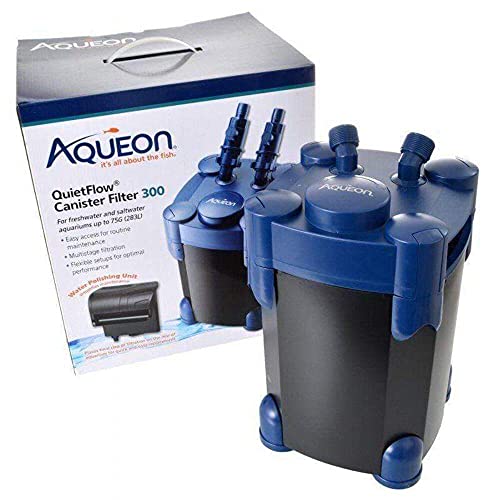
Best for: Owners of 75-gallon community aquariums
The Aqueon Quietflow Canister Filter moves up to 300 gallons per hour and is rated for freshwater or saltwater aquariums up to 75 gallons. It includes intake and output connections, hoses, quick-disconnect valves, and a locking pump head. That setup makes routine servicing easier because you can shut off and detach the canister without placing your hands in the tank.
Its strongest feature is the layered media layout. Coarse foam catches larger debris, activated carbon helps reduce odors and dissolved impurities, and bio-balls plus bio-ceramic rings provide surfaces for beneficial bacteria. A water-polishing unit with its own cartridge handles finer particles. You can adjust the media arrangement for your tank, but replacement cartridges use Aqueon’s system. At around $210, this filter costs more than many hang-on-back models, so the larger capacity and flexible media setup need to justify the price.
Pros
- 300 GPH flow suits aquariums up to 75 gallons.
- Multiple media types support mechanical, chemical, and biological filtration.
- Quick-disconnect valves simplify canister removal during maintenance.
Cons
- Around $210, it costs considerably more than basic hang-on-back filters.
- Canister installation requires space outside the aquarium and careful hose routing.
1. VEVOR 4-Stage Aquarium Canister Filter

Best for: 75- to 100-gallon freshwater tanks
This VEVOR canister filter is designed for aquariums, turtle tanks, and other larger aquatic setups. Its 12W pump moves up to 317 gallons per hour, or 1,200 liters per hour. The four-stage layout uses sponges, ceramic rings, and bio-balls to trap debris and support biological filtration. VEVOR recommends it for tanks up to 100 gallons, though the actual flow can vary with hose placement, media loading, and tank conditions.
Several controls make this filter more flexible than a basic internal pump. A flow valve lets you reduce the output or shut it off during maintenance. The UV lamp includes 4-, 8-, and 24-hour timer settings. Its brushless copper motor is rated below 50 decibels, which should suit living rooms and bedrooms better than louder power filters. Quick-release connections and thicker silicone sealing rings simplify disassembly while helping limit leaks. The inlet also includes an oil-film removal feature for surface debris.
Pros
- Four filtration stages include sponges, ceramic rings, and bio-balls.
- Adjustable flow and UV timer settings support different tank routines.
- Quick-release fittings and reinforced silicone rings make maintenance more manageable.
Cons
- The submersible design takes up space inside the aquarium.
- A 317 GPH maximum may provide less circulation once media and hoses restrict flow.
Buying Guide
For a 75-gallon freshwater aquarium, prioritize usable flow after media and hose resistance. Aim for about 300 to 450 gallons per hour in real operation, not just the manufacturer’s empty-filter rating.
- Flow rate: Choose a model rated for roughly 75 to 100 gallons, with an advertised flow of 500 to 700 GPH. That usually leaves 300 to 450 GPH after setup losses.
- Media capacity: Look for at least three baskets and about 2 to 4 liters of media space. This allows separate mechanical, biological, and chemical media.
- Maintenance design: Select a unit with double-tap valves, a primer, and quick-release hoses. A self-priming model can save several minutes during monthly cleaning.
- Hose and tank fit: Confirm that the intake reaches the tank floor while the return sits near the surface. Standard 5/8-inch or 3/4-inch tubing suits many 75-gallon setups, but verify before buying.
- Cost and operating load: Expect to spend about $120 to $250 for a reliable freshwater canister. Check replacement gasket and media prices, plus power use near 20 to 40 watts.
If you must compromise, prioritize real-world flow and media capacity over extra accessories.
Frequently Asked Questions
How do I choose a canister filter for a 75-gallon freshwater tank?
Choose a canister filter rated for at least 75 gallons, with adjustable flow and space for mechanical, biological, and chemical media. For a heavily stocked tank, a model rated 100 to 150 gallons gives more capacity, but check the actual flow after media and hoses, since manufacturer ratings often reflect empty equipment.
What flow rate does a 75-gallon aquarium filter need?
A 75-gallon freshwater aquarium usually needs a canister filter delivering about 300 to 450 gallons per hour after media and hose resistance. That equals roughly four to six tank turnovers hourly, which suits many community setups. Choose an adjustable pump if you keep delicate fish or plants that prefer gentler circulation.
Can a canister filter handle a 75-gallon freshwater tank?
Yes, a canister filter can run a 75-gallon freshwater tank, provided its rated capacity and actual flow suit the stocking level. A unit rated for 100 gallons can provide useful headroom for fish waste and extra filter media. Clean the prefilter and inspect hoses every two to four weeks to maintain flow.
Are larger canister filters better for 75-gallon tanks?
Larger canister filters are usually better for a 75-gallon aquarium when you need extra media space, but they cost more and take longer to clean. A larger housing may hold several liters of media, while compact models often use less. Check cabinet clearance and hose length before buying, because these units sit below the tank.
Conclusion
The VEVOR 4-Stage Aquarium Canister Filter is the top recommendation for 75-gallon freshwater aquarium owners who want multiple filtration stages and can manage external equipment. If your priority is quieter operation, simpler cleaning, or stronger long-term support, choose the alternative in the roundup that best matches that need instead, since convenience can matter more than extra filter stages. Before buying, double-check the filter’s rated tank size, hose and inlet compatibility, included media quantity, replacement-media availability, and current price. Also confirm that your cabinet has enough room for the canister and that the flow rate suits your fish, plants, and maintenance routine. A good match should improve water clarity without creating unnecessary setup work.