
For most buyers, Turtle Tank Aquarium Filter is the best filter for turtle pond because its turtle-focused design prioritizes water circulation and waste removal. Turtles create more solid waste than many fish, so a filter built for heavier debris can make routine water care less demanding. This pick suits keepers who want a practical starting point rather than a complicated setup.
This guide is for new turtle owners and anyone replacing an undersized pond or tank filter. The most important factors are filter capacity, flow rate, and how easily you can remove and rinse the media. Pond size matters too, since a small unit may struggle in deeper or heavily stocked water. The five picks below are ranked by their useful features, expected maintenance needs, and overall fit. Each one includes clear reasons to consider it, along with honest drawbacks that could affect your choice.
Quick Comparison
| # | Product | Best For | Price | |
|---|---|---|---|---|
| 1 | Turtle Tank Aquarium Filter | Aquatic Turtle Tank Owners | ~$40 | View → |
| 2 | POPOSOAP Pond Filter Pump Fountain Kit | Small Decorative Backyard Ponds | ~$59 | View → |
| 3 | VIVOHOME All-in-One Pond Filter Pump Fountain Kit | Medium Garden Pond Keepers | ~$70 | View → |
| 4 | VIVOHOME 1580GPH Bio Pressure Pond Filter | High-Capacity Biofiltration Systems | ~$129 | View → |
| 5 | VIVOHOME 660GPH Pond Filter Pump Fountain Kit | Compact Fountain Pond Setups | ~$73 | View → |
5 Top Turtle Pond Filter Picks
These pond filters are ranked by cleaning capacity, turtle-safe design, maintenance needs, and value, counting down to the top pick.
5. VIVOHOME 660GPH Pond Filter Pump Fountain Kit

Best for: Small decorative ponds with fountain needs
This 54W all-in-one unit combines a submersible pump, filter, and fountain in one housing. It moves up to 660 gallons per hour, or 2,500 liters per hour, and is rated for ponds up to 1,180 gallons. A 33-foot UL-certified power cord gives more placement flexibility around a garden pond. The IPX8 construction seals the electrical parts inside the chamber, while the exterior is designed for outdoor, wet conditions.
Inside, a filter sponge and bio-balls provide two filtration media types for clearer water and less frequent upkeep than a pump with no filter. Three included nozzles create different spray patterns, so the display can suit a compact pond or water garden. An indicator on top shows when the light is operating. The pump can also run separately as a submersible water pump. At around $73, it offers several functions in one package, but buyers should tighten the bottom-groove screws before use. Unscrew that groove first when taking the filter apart.
Pros
- Combines a 54W pump, filter, fountain, and light in one unit.
- Three nozzles provide different water-spray patterns.
- The 33-foot UL-certified cord supports flexible outdoor placement.
Cons
- The 1,180-gallon rating suits smaller ponds, not large water features.
- Sponge and bio-ball media still need regular cleaning to prevent reduced flow.
4. VIVOHOME 1580GPH Bio Pressure Pond Filter
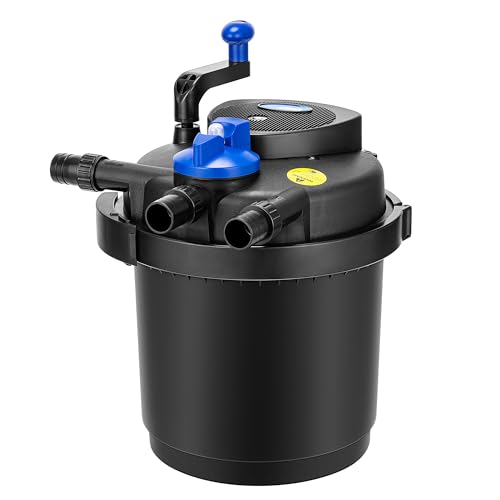
Best for: Small koi and ornamental ponds
This VIVOHOME pressure filter combines mechanical and biological filtration with a built-in 13W clarifying light. It supports ponds up to 1,600 gallons without fish, or up to 800 gallons with fish. Maximum flow reaches 1,580 gallons per hour, though actual performance depends on the separate pump, hose size, and plumbing layout. The strengthened ABS housing is made for outdoor use, and the grounded plug works with 110–120V, 60Hz outlets.
Inside, two blue 20 PPI sponges and two yellow 25 PPI sponges trap debris at different levels. The filter has separate Filter and Clean settings. Turn the handle to backflush the media, then continue until the discharge water runs clear. The manufacturer recommends weekly cleaning, or sooner if the red float rises. Three adapters fit 3/4-inch, 1-inch, and 1-1/4-inch hoses. Using the largest compatible hose should help reduce flow restrictions. At around $129, it offers useful filtration features for modest pond systems, but the pump adds to the total cost.
Pros
- Supports up to 1,600-gallon ornamental ponds.
- Four reusable sponges provide coarse and fine filtration.
- Backflush control simplifies routine cleaning.
Cons
- A separate water pump is required for operation.
- The 13W light adds electrical needs but does not replace regular filter cleaning.
3. VIVOHOME All-in-One Pond Filter Pump Fountain Kit
Best for: Small backyard ponds with fountain displays
The VIVOHOME 530GPH system combines a submersible pump, pond filter, fountain nozzles, and light in one 42W unit. Its listed maximum flow reaches 2,000 L/H, enough for ponds up to 920 gallons under suitable conditions. A 33-foot UL-certified power cord gives you more placement flexibility around a garden pond.
Inside, a filter sponge and bio-balls provide two types of filtration. They help trap debris and support clearer water, though this system still needs regular cleaning. The kit includes three nozzle styles, so you can change the spray pattern without buying separate fountain parts. Its IPX8-rated electrical housing is sealed against water, while the weatherproof outer materials suit outdoor use. The light indicator on top shows whether the lamp is operating. A bottom-groove screw must be tightened for a proper seal, and it needs to be loosened before disassembly. At around $70, it offers several pond functions in one package.
Pros
- Combines a 530GPH pump, filter, fountain, and light in one unit.
- Three nozzle options let you change the water display.
- A 33-foot UL-certified cord supports flexible outdoor placement.
Cons
- The sponge and bio-balls require periodic cleaning, especially in ponds with leaves or algae.
- The 42W pump uses more power than smaller decorative fountain units.
2. POPOSOAP Pond Filter Pump Fountain Kit

Best for: Small koi ponds with fountains
The POPOSOAP pond filter combines a filter box, pump, and fountain kit in one outdoor unit. Its 40W pump moves up to 660 gallons per hour, with the manufacturer listing it for ponds up to 1,180 gallons. The corded design needs access to a suitable outdoor outlet. Inside, filter pads, filter balls, and bio-ceramic rings capture debris and provide space for biological filtration.
The kit includes three fountain nozzles for different spray patterns. A diverter valve lets you run the fountain and a second water feature, such as a waterfall, at the same time. Flow controls adjust both outlets. Three extra inlets support hose connections, though hoses for a separate waterfall may not be included. Clips provide quick access to the filter box for cleaning. Around $59, it offers a practical setup for smaller water gardens, plus a one-year warranty. It still requires regular cleaning, especially in ponds with leaves, algae, or many fish.
Pros
- Combines a 660 GPH pump, filter box, and fountain parts in one kit.
- Includes three spray nozzles and adjustable controls for fountain or waterfall use.
- Uses filter pads, filter balls, and bio-ceramic rings for multiple filtration stages.
Cons
- The 40W corded pump requires a safe outdoor electrical outlet and suitable cord placement.
- A 660 GPH rating may provide limited circulation in larger ponds or systems with long hose runs.
1. Turtle Tank Aquarium Filter

Best for: Large turtle and fish tanks
This adjustable power filter is designed for aquariums from 20 to 75 gallons. Its pump moves up to 290 gallons per hour, with a control that lets owners reduce the current for slower swimmers or smaller fish. The waterfall outlet also adds surface movement, which helps aerate the water.
Filtration uses a double-sided white and black mesh sponge to catch waste, uneaten food, leaves, and fine debris. A later stage uses ceramic bio-balls with open pores and plenty of surface area for beneficial bacteria. The media can help reduce odors and discoloration as waste breaks down. A top-access canister makes cleaning or replacing media easier, and the filter can run in freshwater or saltwater setups. It needs at least 2.6 inches of water, so it fits many turtle habitats but not very shallow containers. Around $40, it offers a solid feature set for larger tanks, though buyers should plan for regular sponge and media maintenance.
Pros
- Adjustable flow supports turtles, fish, frogs, and other aquatic animals.
- Double-sided sponge catches food scraps, leaves, waste, and small particles.
- Ceramic bio-balls provide porous surface area for biological filtration.
Cons
- The 2.6-inch minimum water level rules out some shallow habitats.
- Its 20-to-75-gallon rating may be excessive for smaller aquariums, even at reduced flow.
Buying Guide
The most important factor is filter capacity, because turtles produce more waste than similarly sized fish. Choose a unit rated for at least twice your pond’s actual volume to keep water clearer between cleanings.
- Pond rating: Match the filter to a pond size at least 2 times smaller than its advertised maximum. For a 300-gallon pond, choose a model rated for 600 gallons or more.
- Flow rate: Aim to circulate the full pond volume every 1 to 2 hours. A 300-gallon setup needs roughly 150 to 300 gallons per hour after hose and height losses.
- Filtration stages: Look for mechanical and biological media in the same system. A coarse sponge catches debris, while ceramic rings or bio-balls provide space for beneficial bacteria.
- Maintenance access: Choose a filter with removable pads and a drain or backflush setting. Rinse media with pond water every 1 to 4 weeks, not chlorinated tap water.
- Turtle safety: Cover intake openings with a guard or pre-filter sponge. Keep electrical parts rated for outdoor use, and use a ground-fault circuit interrupter outlet.
If you cannot have everything, prioritize oversized filtration capacity over extra features.
Frequently Asked Questions
How do I choose a filter for a turtle pond?
Choose a turtle pond filter with mechanical and biological stages, sized for two to three times the pond’s actual volume per hour. Turtles produce heavy waste, so extra capacity helps maintain water quality. For a 500-gallon pond, consider a system rated around 1,000 to 1,500 gallons per hour before hose losses.
What size filter does a turtle pond need?
A turtle pond needs a filter rated for roughly two to three times its water volume per hour. This higher turnover rate helps manage waste, food scraps, and stirred-up sediment. A 300-gallon pond should usually use filtration rated between 600 and 900 gallons per hour.
Can a pond filter keep turtle water clear?
Yes, a properly sized pond filter can keep turtle water clearer, but it cannot replace routine maintenance. Clean mechanical pads every one to two weeks, and rinse biological media with removed pond water. Replace part of the water every two to four weeks, depending on test results.
Are UV filters necessary for turtle ponds?
No, a UV clarifier is not necessary, but it can reduce green-water algae in sunny ponds. Use one when water remains cloudy despite proper filtration and cleaning. Check the unit’s pond rating, since many models cover specific ranges such as 500, 1,000, or 2,000 gallons.
Conclusion
Turtle Tank Aquarium Filter remains the top recommendation for turtle owners who want a practical option for routine pond or tank care. It suits buyers who prefer a dedicated turtle setup over a general aquarium filter, especially when the water needs steady circulation and waste control. If your priority is lower upkeep, pick a model with removable filter media and easy-access parts, since quicker cleaning may matter more than extra features. Before buying, double-check the filter’s size rating, compatibility with your pond or tank, the quantity included, and the current price. The right match should fit your water volume, leave turtles enough swimming space, and use replacement media that is easy to find when needed.