
Westaho Salt Chlorine Generator is the top pick for most buyers in these best saltwater chlorine generator reviews because it offers a straightforward way to turn pool salt into chlorine. That setup can reduce the need to measure and add chlorine by hand, while keeping the core maintenance routine familiar.
This guide is for pool owners comparing salt-based systems for easier water care. The most important details are pool size compatibility, chlorine output, installation requirements, and replacement cell cost. Those factors affect whether a unit fits your equipment and budget. The seven picks below are ranked with clear reasons and honest drawbacks for each, so you can narrow the list with fewer surprises.
Quick Comparison
| # | Product | Best For | Price | |
|---|---|---|---|---|
| 1 | Westaho Salt Chlorine Generator | Budget-conscious pool owners | ~$130 | View → |
| 2 | TP30 Salt Chlorine Generator | Small above-ground pools | ~$800 | View → |
| 3 | Hayward AquaRite Salt Chlorine Generator | In-ground pool upgrades | ~$2199 | View → |
| 4 | Bestway Flowclear Hydrogenic Saltwater Chlorinator | Bestway pool owners | ~$300 | View → |
| 5 | INTEX QS1200 Saltwater Chlorine System | High-volume chlorine production | ~$182 | View → |
| 6 | Westaho Salt Chlorine Generator | Replacement system shoppers | ~$180 | View → |
| 7 | Westaho WiFi Salt Chlorine Generator | App-connected pool maintenance | ~$200 | View → |
7 Saltwater Chlorine Generators Worth Considering
These ranked picks are ordered from solid options at number seven to our top choice at number one.
7. Westaho WiFi Salt Chlorine Generator

Best for: Hot tub owners wanting app control
This Westaho salt chlorine generator converts compatible hot tubs and swim spas to salt-water sanitation. It supports vessels from 200 to 2,200 gallons, so it fits many residential spas but not larger pools. Setup does not require plumbing or tools. Place the chlorinator in the water, mount the controller, and connect it to power.
The GeniLife app connects over 2.4GHz or 5GHz WiFi. It shows salt levels, system status, and water temperature from 50°F to 104°F. Low-salt alerts appear on the controller and in the app, which can reduce guesswork during routine care. The U.S.-made titanium cell has a claimed lifespan of more than 3,000 hours, about 40% longer than standard cells. The unit costs around $200, though prices change. It may help reduce chlorine odor and skin discomfort, but water balance still requires regular attention.
Pros
- Supports a wide range of spa sizes, from 200 to 2,200 gallons.
- Dual-band WiFi provides remote salt, temperature, and status checks.
- The titanium cell is rated for more than 3,000 operating hours.
Cons
- It only suits hot tubs and swim spas within the stated 2,200-gallon limit.
- Salt sanitation does not remove the need to check water chemistry and maintain the spa.
6. Westaho Salt Chlorine Generator
Best for: Hot tub owners wanting easier water care
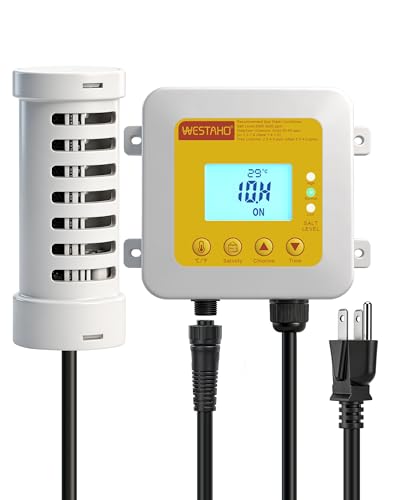
This Westaho salt chlorine generator converts salt into chlorine for hot tubs and swim spas from 200 to 2,200 gallons. It sits in the water, while the controller mounts nearby, so setup requires no plumbing or tools. The company says installation takes about five minutes. At around $180, it costs less than many permanent systems, but it still requires salt and routine water checks.
The U.S.-made titanium cell is rated for more than 3,000 operating hours, which may reduce replacement frequency compared with shorter-lived cells. LED indicators show system status and salinity, and the automatic run feature can maintain chlorine production based on your settings. Water may clear within a few hours when conditions are suitable, but results depend on the starting water, salt level, filtration, and overall balance. The compact design fits temporary or portable spa setups better than a built-in pool system.
Pros
- Works with hot tubs and swim spas from 200 to 2,200 gallons.
- Titanium cell offers a rated lifespan of over 3,000 hours.
- Tool-free setup and LED indicators simplify routine operation.
Cons
- Salt chlorine does not mean chemical-free care. You still need to monitor water balance and chlorine levels.
- The system may not suit owners who want a fully integrated, permanent installation.
5. INTEX QS1200 Saltwater Chlorine System

Best for: Above-ground pools up to 15,000 gallons
The INTEX Krystal Clear QS1200 converts a compatible above-ground pool into a saltwater setup. It is rated for pools up to 15,000 gallons and requires a filter pump moving between 700 and 3,200 gallons per hour. The system connects to the INTEX 26669EG filter pump, then uses added salt to produce chlorine for routine water care. It can reduce the need to handle several separate pool chemicals, but it still requires regular water testing and maintenance.
The control panel keeps daily scheduling simple. A built-in 24-hour timer supports automatic operation, while three self-cleaning cycles run for 6, 10, or 14 hours. INTEX also includes hydroaeration technology, which adds air to the returning water to support circulation and filtration. At around $182, it costs more than basic chlorine dispensers, but it offers a more automated approach. A 2-year limited warranty adds some purchase protection.
Pros
- Supports pools up to 15,000 gallons, covering many larger above-ground models.
- Three self-cleaning cycles and a 24-hour timer reduce daily manual setup.
- Hydroaeration can improve water circulation, filtration, and surface clarity.
Cons
- It needs a compatible pump with a 700 to 3,200 gallons-per-hour flow rate.
- Saltwater operation does not remove pool maintenance. Owners still need to check water chemistry and maintain the filter.
4. Bestway Flowclear Hydrogenic Saltwater Chlorinator

Best for: Saltwater pools up to 15,000 gallons
The Bestway Flowclear Hydrogenic 12 G/H Digital Self Cleaning Saltwater Chlorinator treats pools up to 15,000 gallons when paired with a compatible filter pump rated for at least 330 gallons per hour. It converts dissolved salt into 12 grams of chlorine per hour, which can reduce the need for frequent manual chlorine additions. The saltwater setup may also feel gentler on skin, eyes, hair, and swimsuits than heavily chlorinated water.
Its strongest feature is the automatic self-cleaning mode, which reduces buildup inside the chlorinator. A green and red LED system provides basic operating and issue alerts, so owners can check its status quickly. The package includes five 3-in-1 strips for free chlorine and total alkalinity, plus 25 saltwater strips for checking salt levels. Each strip uses an instant color-match system. At around $300, this unit costs less than many complete pool sanitation systems, but it only handles chlorine generation.
Pros
- Produces 12 grams of chlorine per hour for pools up to 15,000 gallons.
- Automatic self-cleaning mode can reduce routine internal maintenance.
- Includes 30 total test strips for chlorine, alkalinity, and salt checks.
Cons
- Requires a separate compatible filter pump with at least 330 gallons-per-hour flow.
- It does not replace filtration, debris removal, or regular water testing.
3. Hayward AquaRite Salt Chlorine Generator

Best for: Large residential pool owners
The Hayward AquaRite Salt Chlorine Generator is built for swimming pools up to 40,000 gallons. It creates chlorine from dissolved salt, then distributes it through the pool system to support steady sanitation. The unit fits into an existing setup without additional plumbing, which can simplify installation for compatible pools. At around $2,199, it requires a large upfront investment.
Its LED monitor displays operating information and service alerts, so owners can spot maintenance needs without mixing liquid chlorine or handling tablets. Hayward claims the system can reduce operating costs by 50% or more compared with conventional chlorine treatments, though actual savings depend on pool size, usage, and local chemical prices. Salt-generated chlorine may also feel gentler on skin and swimsuits, but it still requires routine water testing and chemical balancing.
Pros
- Supports pools up to 40,000 gallons with steady chlorine production.
- LED alerts help track service needs and routine maintenance.
- Salt-based operation may reduce chlorine handling and ongoing chemical costs.
Cons
- Around $2,199 makes it expensive compared with basic tablet or liquid chlorine setups.
- It still requires regular pool testing, salt-level checks, and compatible existing plumbing.
2. TP30 Salt Chlorine Generator

Best for: Large residential pools needing app controls
The TP30 is a salt chlorine generator rated for residential pools up to 40,000 gallons. It converts pool salt into chlorine, which can reduce the need to handle chlorine products by hand. The system includes both a control panel and app access. From either one, owners can check chlorine output, salt level, water temperature, flow status, and system alerts.
Its clear cell housing makes visual checks easier than with an opaque cell. Automatic reverse polarity can help limit scale buildup on the cell and support consistent chlorine production. The unit uses standard pool plumbing and includes threaded unions with a matching installed length for compatible layouts. It is designed to retrofit plumbing used by Pentair IntelliChlor IC20, IC40, and IC60 systems, but it is not affiliated with Pentair. The package includes a TROXLLY power adapter. ETL listing and app diagnostics add useful safety and setup information. At around $800, it costs more upfront than basic manual chlorination equipment.
Pros
- Supports pools up to 40,000 gallons.
- App and panel show salinity, flow, temperature, output, and alerts.
- Clear cell and reverse polarity simplify inspection and scale control.
Cons
- Compatibility depends on the existing plumbing layout, even with standard threaded unions.
- Around $800 is a substantial upfront cost, before installation or replacement-cell expenses.
1. Westaho Salt Chlorine Generator

Best for: Above-ground pool owners seeking easier chlorination
The Westaho salt chlorine generator is made for above-ground pools up to 15,000 gallons. It works with Intex, Bestway, Summer Waves, Doughboy, and similar setups. The system turns dissolved salt into chlorine, which can reduce how often you buy and handle bottled chlorine. Its IP66 waterproof rating adds protection for outdoor pool equipment. At around $130, it costs less upfront than many full-size pool sanitation systems, though prices can change.
Its control panel shows salt level, water temperature, cell usage time, operating voltage, and current. That information gives you more detail than a basic timer. The USA-made titanium cell system uses three cells and is designed for up to 2,800 hours of operation. A magnetic flow switch avoids the moving parts found in many mechanical switches. The unit also shuts off when water drops below 52°F, which helps prevent operation in cold conditions. Buyers should still expect regular water checks and seasonal maintenance.
Pros
- Supports above-ground pools up to 15,000 gallons.
- Displays salt level, temperature, voltage, current, and cell usage.
- Magnetic flow switch and low-temperature cutoff help protect the system.
Cons
- It still requires salt additions and routine pool chemistry checks.
- It is limited to above-ground pools and may not suit larger systems.
Buying Guide
Pool volume compatibility is the most important factor because an undersized cell may not produce enough chlorine during hot weather. Match the unit’s rated capacity to your pool size, then allow extra output for heavy use.
- Pool capacity: Choose a model rated for at least 25% more water than your pool holds. A 20,000-gallon pool should use a unit rated for 25,000 gallons or more.
- Chlorine output: Compare production in pounds per day or grams per hour. For many residential pools, 0.5 to 1.5 pounds per day provides a useful range.
- Salt range: Confirm the required salt level, commonly 2,700 to 3,400 parts per million. Select a model with a digital salt reading and a low-salt warning.
- Cell lifespan: Look for a replaceable cell rated for at least 5,000 operating hours. A self-cleaning cell can reduce calcium buildup, but it still needs regular inspection.
- Installation and cost: Check pipe size, voltage, flow-switch requirements, and warranty length. Most complete systems cost about $500 to $2,000, while replacement cells often cost $300 to $800.
If you cannot have everything, prioritize correct pool sizing, since extra features cannot fix inadequate chlorine output.
Frequently Asked Questions
How do saltwater chlorine generators work?
Saltwater chlorine generators turn dissolved salt into chlorine as pool water passes through an electrolytic cell. The system does not create a chlorine-free pool, but it can reduce routine chemical dosing. Many residential units use salt levels around 2,500 to 3,500 parts per million, though the required range depends on the model.
What size salt chlorinator do I need?
Choose a salt chlorinator rated for your pool’s volume, then consider a unit sized at least 25% above that capacity. Oversizing gives the cell more operating room during hot weather or heavy use. For a 20,000-gallon pool, a model rated for 25,000 gallons is a practical starting point, if the manufacturer allows it.
Can a saltwater chlorine generator work with an above-ground pool?
Yes, a saltwater chlorine generator can work with many above-ground pools if its flow rate, plumbing size, and salt requirement match the equipment. Check the manual before buying, since some systems need hard-plumbed connections. A compatible unit may require roughly 2,500 to 3,500 ppm of salt in the water.
Are saltwater pool systems worth the cost?
Saltwater pool systems can be worth the cost for owners who want steadier chlorine production and less frequent manual dosing, but they still require testing and upkeep. The initial system cost is higher than basic chlorine treatment, and a replacement cell may be needed after roughly 3 to 7 years, depending on use and care.
Conclusion
Westaho Salt Chlorine Generator is our top pick for pool owners who want a practical saltwater system with straightforward daily chlorine production. If your priority is a lower upfront cost, pick a budget generator instead, while a higher-output model makes more sense for larger pools because its cell can support greater water volume. Before buying, double-check your pool’s size, plumbing and electrical compatibility, included quantity, and current price. A generator should match the water volume, not just the brand or advertised coverage. Also check replacement-cell costs and warranty terms, since those expenses affect long-term value. Keep the cell clean, follow the manufacturer’s salt guidance, and monitor chlorine and pH levels regularly for reliable pool care.