
The BN-LINK 7-Day Programmable Digital Timer Outlet is the top pick for most buyers and the best aquarium timer for flexible daily scheduling. Its seven-day programming lets you set different on and off times for weekdays and weekends, so lighting does not need daily adjustments. It is a programmable outlet, not a dedicated aquatic device, but that design suits many home setups.
This guide is for freshwater and saltwater aquarium owners who want steadier lighting routines. The key factors are the timer’s physical size, outlet layout, programming options, and compatibility with your light or pump. A compact design matters when space behind the tank is limited. Reliable schedules also help manage consistent light periods. The 7 picks below are ranked with clear reasons and honest drawbacks for each.
Quick Comparison
| # | Product | Best For | Price | |
|---|---|---|---|---|
| 1 | BN-LINK 7-Day Programmable Digital Timer Outlet | Weekly home lighting schedules | ~$13 | View → |
| 2 | DaToo Aquarium Light Timer & Dimmer | Basic aquarium light automation | ~$10 | View → |
| 3 | NICREW Aquarium Light Timer & Dimmer | Adjustable planted tank lighting | ~$10 | View → |
| 4 | Novique Aquarium Light Timer Dimmer | Compact reef lighting control | ~$9 | View → |
| 5 | BN-LINK 8-Outlet Surge Protector with Mechanical Timer | Multi-device timed power management | ~$23 | View → |
| 6 | DEWENWILS 24-Hour Programmable Digital Timer Outlet | Daily appliance scheduling | ~$14 | View → |
| 7 | Coralife 8-Outlet Digital Aquarium Timer | Multi-outlet aquarium equipment control | ~$37 | View → |
7 Aquarium Timers Worth Buying
This ranked list counts down from practical aquarium timers to the top pick, with key features and limitations noted for each model.
7. Coralife 8-Outlet Digital Aquarium Timer

Best for: Aquarium lighting and filter schedules
The Coralife 8-outlet power center combines aquarium power distribution with a 24-hour mechanical timer. It has eight grounded outlets, a three-prong plug, and a 3-foot power cord. Sliding covers shield unused outlets from accidental contact. The timer uses 15-minute intervals, giving you control over when connected equipment turns on and off.
You can set up to seven cycles each day, with scheduling available across all seven days of the week. That suits many common aquarium routines, such as running lights during the day while keeping filters and air pumps powered continuously. The UL listing adds a useful safety check. At around $37, it costs more than a basic power strip, but it can replace a separate timer for timed equipment. Just remember that this is a mechanical timer, despite the “digital power center” name.
Pros
- Eight outlets provide room for lights, filters, heaters, air pumps, and other aquarium equipment.
- Seven daily cycles and 15-minute settings support detailed lighting schedules.
- Sliding covers protect outlets that are not in use.
Cons
- The 15-minute interval system cannot schedule equipment at more precise times.
- A 3-foot cord may be too short for tanks positioned far from the wall outlet.
6. DEWENWILS 24-Hour Programmable Digital Timer Outlet

Best for: Indoor lamps on daily schedules
The DEWENWILS Indoor Digital Timer adds scheduled control to one outlet. Its 24-hour clock lets you set up to three daily programs, each with an on time and an off time. Four buttons handle programming, while a side switch selects Always On, Auto, or Always Off. The large display makes the current setting easier to read. Around $14, it costs little compared with smart plugs, though it does not offer app control or remote access.
Its compact body leaves the neighboring socket usable, and the smooth sides with a frosted front look less bulky than many mechanical timers. Operation is silent, so it suits bedrooms, living rooms, and plant-light setups. A backup battery keeps saved schedules for up to three months after a power loss or unplugging. The timer works with 125V, 60Hz loads up to 15A or 1,000W and uses a grounded three-prong design. A one-year warranty adds some purchase protection.
Pros
- Stores three repeating daily schedules for lamps, holiday lights, or plant lights.
- Backup battery preserves programmed settings for up to three months.
- Silent operation and a compact single-outlet design fit bedrooms and crowded outlets.
Cons
- One outlet limits how many devices you can control at once.
- Indoor use and the 1,000W maximum rule out outdoor equipment and some high-power appliances.
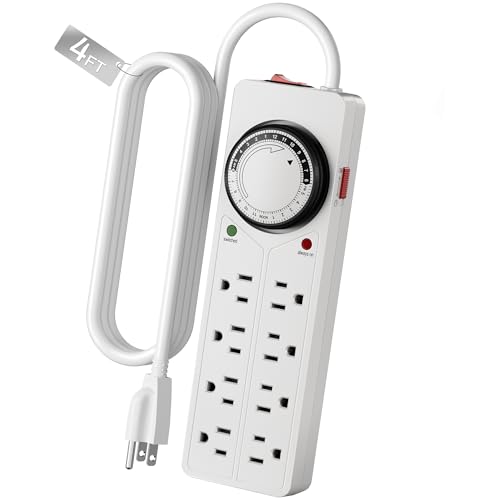
5. BN-LINK 8-Outlet Surge Protector with Mechanical Timer
Best for: Scheduled aquarium and plant equipment
The BN-LINK power strip combines eight surge-protected outlets with a mechanical 24-hour timer. Four outlets follow the timer, while the other four remain powered continuously. The dial supports settings in 15-minute increments, so you can create repeating daily schedules for lamps, pumps, fans, or other indoor equipment. A 3-foot power cord keeps the setup fairly compact, though the product name lists a 4-foot cord.
Two colored LEDs show which outlet row is active. An override switch can keep the timed row on without changing the schedule. The unit also includes a circuit breaker and three-line surge protection rated at 800V across line-to-neutral, line-to-ground, and neutral-to-ground paths. It is ETL listed for indoor use and rated for 1875 watts. The published information shows both 10A and 15A ratings, so buyers should confirm the exact rating before connecting high-draw devices. At around $23, it offers useful scheduling without a digital display or app.
Pros
- Eight outlets provide four timed connections and four always-on connections.
- Fifteen-minute timer increments support specific daily schedules.
- Circuit breaker, LEDs, and 800V three-line surge protection add useful safeguards.
Cons
- The short 3-foot cord may not reach distant wall outlets.
- Mechanical pins require manual setup, and the schedule repeats every 24 hours without weekly variations.
4. Novique Aquarium Light Timer Dimmer

Best for: single-channel aquarium LED strips
This inline controller adds scheduling and dimming to compatible aquarium lights. It works with 5-24V DC, single-channel LED strips that use a standard 5.5 x 2.1mm barrel connector. The unit offers three listed lighting schedules, 8, 10, or 12 hours, plus 10 brightness levels. At around $9, it is a low-cost way to add basic control without replacing an entire lamp.
Its most useful feature is the gradual transition. The light ramps up for 15 minutes at the start and fades for 15 minutes at the end, instead of switching on or off abruptly. Separate controls handle the timer and brightness, so adjusting one should not change the other. The compact body can help limit cable clutter, but compatibility matters. This is a single-channel controller, not a multi-color or multi-zone aquarium system. It also lacks a battery backup. If power fails, the brightness level remains saved, but the timer stops and needs to be selected again. The instructions mention 4, 8, or 12 hours after an outage, which does not fully match the listed 8, 10, and 12-hour options.
Pros
- Supports 5-24V DC LED strips with a 5.5 x 2.1mm connector.
- Provides 10 brightness steps for softer or stronger light.
- Uses 15-minute sunrise and sunset transitions.
Cons
- A power outage disables the timer until you reset it.
- It controls one channel and cannot manage separate colors.
3. NICREW Aquarium Light Timer & Dimmer

Best for: Simple single-channel aquarium lighting
This NICREW controller adds basic timing and dimming to compatible aquarium LEDs. It works with 5.5mm x 2.1mm barrel connectors and 5–24V DC, single-channel LED strips or fixtures. That range covers many small and medium aquarium lights, but buyers should check the connector and voltage before ordering. Installation is simple, since the controller fits between the light and its power supply.
What stands out is the balance of price and control. Around $10, it provides three preset modes, including gradual sunrise and sunset effects. The power button switches the programmed on/off mode, while plus and minus buttons adjust brightness from 10% to 100%. That gives you a dim nighttime setting without changing the light itself. The design stays focused on basic daily automation, though. It does not offer separate control for different color channels, and the three preset modes may feel limited if you want a detailed custom schedule.
Pros
- Supports 5–24V DC lights with a common 5.5mm x 2.1mm connector.
- Offers three preset modes, including sunrise and sunset transitions.
- Adjusts brightness manually from 10% to 100%.
Cons
- Single-channel operation cannot control separate color channels independently.
- Only three preset modes are available, with no stated custom scheduling options.
2. DaToo Aquarium Light Timer & Dimmer

Best for: Small aquariums needing scheduled LED lighting
This DaToo controller adds timer and brightness controls to compatible aquarium LEDs. It works with 5–24V DC lights and uses a 5.5 x 2.1mm barrel connector, so it can provide simple plug-in control when the light and connector match. The single-channel design suits one light or one LED strip, not separate control zones.
You can choose 4-, 8-, or 12-hour timing with the clock button. Six brightness levels range from 10% to 100%, giving you more control than a basic on/off timer. Lower settings can create dimmer morning or evening light, while full brightness supports normal daytime use. The plastic housing is compact and lightweight, and the controller costs around $10. Its low-voltage design fits many small tank setups, but buyers should confirm voltage, connector size, and polarity before ordering.
Pros
- Offers three timer choices, 4, 8, and 12 hours, for repeatable lighting schedules.
- Provides six brightness settings from 10% to 100% for gentler light transitions.
- Supports 5–24V DC LED lights with a common 5.5 x 2.1mm barrel connector.
Cons
- The single-channel setup cannot control two aquarium lights independently.
- After a power outage, the timer must be set again, since it returns to timer-off mode.
1. BN-LINK 7-Day Programmable Digital Timer Outlet

Best for: Automating lamps and small appliances
The BN-LINK Indoor 7-Day Programmable Digital Timer Outlet adds scheduled control to a standard 120V wall socket. It has two grounded outlets, but both turn on and off together. You can create up to eight on/off programs across the week, with settings as short as one minute. The 15A, 1725W maximum rating suits many lamps, coffee makers, fans, and other compatible household devices. At around $13, it offers useful scheduling without much cost.
The controls support individual weekdays or preset day combinations, such as weekdays or weekends. A dedicated button adjusts the clock for Daylight Saving Time. Its backup battery preserves programmed settings during a power outage, though the listing does not state how long that battery lasts. Random vacation mode changes programmed light times, which can make an empty home appear occupied. The timer is ETL listed, but buyers still need to stay below its electrical rating and use devices approved for timer control.
Pros
- Eight weekly programs allow detailed schedules, including one-minute intervals.
- Backup battery keeps settings saved during power interruptions.
- Random mode varies light timing while you are away.
Cons
- Both outlets operate together, so they cannot run separate schedules.
- The 1725W limit may exclude high-power heaters and other demanding appliances.
Buying Guide
The most important factor is schedule control. Aquarium lights, air pumps, and feeders need consistent daily timing, and a timer with flexible settings can prevent missed cycles.
- Programming options: Choose at least one daily on/off cycle, or two to four events if you need separate light and feeding schedules. Minute-level adjustments offer better control than basic 30-minute increments.
- Power rating: Match the timer to your equipment’s total draw. For most small tanks, a 15-amp, 1,875-watt rating provides ample capacity, but never exceed the manufacturer’s limit.
- Outlet layout: Pick a model with two to four grounded outlets when controlling several devices. Separate or individually controlled outlets prevent every accessory from switching on together.
- Backup protection: Look for a battery backup that preserves settings for at least 8 to 24 hours during an outage. Without this feature, the schedule may reset after a power failure.
- Build and placement: Select a timer with a grounded plug, heat-resistant housing, and a cord at least 3 feet long. A compact design under 4 inches wide fits crowded aquarium stands more easily.
If you cannot have everything, prioritize reliable scheduling with battery backup, since inconsistent timing can disrupt the tank’s daily routine.
Frequently Asked Questions
How do aquarium timers work?
An aquarium timer switches connected equipment on and off at programmed times. Most models follow a 24-hour schedule, so you can set lights for eight hours daily and repeat that cycle. Mechanical versions use pins or tabs, while digital units may offer multiple settings and minute-level control.
What should I look for in an aquarium light timer?
Look for an aquarium timer with a load rating above the equipment’s total wattage, reliable scheduling, and a battery backup if outages are common. A practical choice may support at least two daily on/off events, use a grounded plug, and include an easy-to-read display or simple override button.
Can a fish tank timer run lights and filters?
Yes, a timer can control aquarium lights, air pumps, and some filters, provided its outlet rating matches the device. Check the label before connecting anything, especially motors. For example, a 15-amp model may handle several low-watt LED fixtures, but the manufacturer’s wattage and motor limits still apply.
Are digital aquarium timers better than mechanical ones?
Digital aquarium timers are better for precise schedules, while mechanical models suit simple light cycles and usually cost less. A digital unit may allow seven separate daily programs, whereas a dial timer often repeats one 24-hour pattern. Choose based on required control, outlet load, and power reliability.
Conclusion
The BN-LINK 7-Day Programmable Digital Timer Outlet is the top pick for aquarium owners who want repeatable lighting schedules, flexible programming, and a straightforward outlet design. If your priority is simple setup and lower cost, pick a mechanical timer instead, since its dial is easier to adjust and does not depend on digital controls. Before buying, double-check the timer’s physical size, outlet and plug compatibility, number of outlets, and current price, since these details can change how well it fits your equipment and budget. Also confirm that the schedule supports your aquarium’s lighting routine, especially if you need separate on and off times across the week.