
For most buyers, the SICCE Nano Micron Internal Aquarium Filter is the best micron filter for aquarium use. Its main advantage is its compact internal format, which saves space inside smaller tanks. It is a practical choice when you want fine mechanical filtration without placing a large unit outside the aquarium.
This guide is for aquarium owners comparing compact filters for nano and small freshwater or marine setups. The key choices are tank size, media design, and flow control, since those affect fit, water clarity, and cleaning time. The five picks below are ranked with clear reasons and honest drawbacks for each, so you can match a model to your tank and maintenance routine.
Quick Comparison
| # | Product | Best For | Price | |
|---|---|---|---|---|
| 1 | SICCE Nano Micron Internal Aquarium Filter | Small Nano Tank Owners | ~$30 | View → |
| 2 | Aquatic Experts Aquarium Polishing Filter Pad | Cloudy Water Cleanup | ~$16 | View → |
| 3 | Marineland Magnum Canister Aquarium Filter | High-Capacity Reef Tank Filtration | ~$77 | View → |
| 4 | Aquatic Experts Aquarium Polishing Filter Pad | Fine Particle Water Polishing | ~$16 | View → |
| 5 | AQUANEAT Aquarium Filter Media Bags, 6-Pack | Multi-Media Filter Organization | ~$9 | View → |
5 Top Micron Filters for Aquariums
These five aquarium micron filters are ranked by filtration control, maintenance needs, and value, counting down to the top pick.
5. AQUANEAT Aquarium Filter Media Bags, 6-Pack

Best for: Small aquarium media setups
The AQUANEAT set includes six reusable filter media bags, each measuring 5.5 by 8 inches. Their 100-micron mesh holds activated carbon, resin, ceramic pieces, and other small media without letting fine particles escape easily. The extra-fine material works well when loose media would otherwise spread through a filter chamber. Each bag has a plastic zipper across the top, so you can fill, empty, and close it without tying a separate fastener.
These pouches fit many filtration systems, including canister filters, power filters, sumps, wet/dry filters, and pond setups. They work in both freshwater and saltwater aquariums. The washable construction supports repeated use, which helps reduce the need for disposable media sleeves. At around $9 for six bags, the set offers a low-cost way to organize filter materials. Still, the 100-micron mesh may collect debris quickly in dirty tanks, and the 5.5-by-8-inch size may not fit smaller filter compartments.
Pros
- Six bags provide separate storage for different media types.
- 100-micron mesh holds activated carbon and fine filter material.
- Plastic zippers allow quick filling and removal.
Cons
- Fine mesh can restrict water flow as debris builds up.
- The fixed 5.5-by-8-inch size may be too large for compact filters.
4. Aquatic Experts Aquarium Polishing Filter Pad
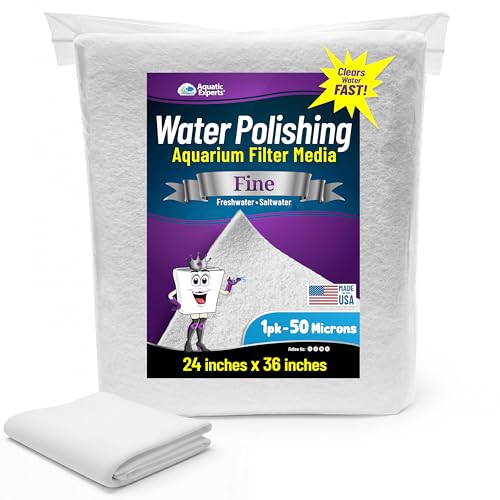
Best for: DIY aquarium filter media users
The Aquatic Experts Aquarium Polishing Filter Pad is a fine mechanical filter sheet for fish tanks, sumps, wet/dry filters, and aquaponics systems. Its 50-micron polyester fibers catch small particles suspended in the water. The single pad measures 24 by 36 inches and is 1/8 inch thick, giving you a large sheet to cut for different filter chambers. At around $16, it costs less than buying multiple small, pre-cut pieces.
The pad’s main advantage is flexibility. You can trim it around a filter basket, layer it with coarser media, or place it where water flows through the system. Interwoven polyester gives the material more structure than loose filter floss, and the manufacturer says it can be cleaned in a washing machine. Still, fine media collects debris quickly. Frequent rinsing or replacement may be needed, especially in tanks with heavy waste or cloudy water. Cutting the large sheet also takes extra time, but one pack can supply many custom-sized inserts.
Pros
- 50-micron filtration catches fine particles that coarser media may leave behind.
- The 24-by-36-inch sheet fits many setups after cutting.
- Polyester construction can be washed and reused, according to the manufacturer.
Cons
- Fine fibers load with debris quickly, so regular cleaning is necessary.
- The large sheet requires measuring and cutting before installation.
3. Marineland Magnum Canister Aquarium Filter

Best for: Large freshwater tanks needing clear water
The Marineland Magnum 290 GPH is a compact canister filter for aquariums up to 97 gallons. Its submerged motor helps it start quickly, while continuous three-stage filtration handles routine water cleaning. The 290 gallons-per-hour rating gives it enough capacity for larger home aquariums, though actual flow can vary once media and tubing are installed.
Its strongest feature is flexibility. Two refillable chambers can hold carbon or other filter media, so owners can adjust filtration for their tank. The included micron cartridge adds fine water polishing, which can help remove small particles and improve clarity. Around $77, it costs more than many basic internal filters, but the refillable design may reduce the need to replace the entire unit. The main drawback is upkeep. Canister filters need regular cleaning, and the fine cartridge can collect debris quickly in a dirty aquarium.
Pros
- Filters up to 290 gallons per hour for aquariums as large as 97 gallons.
- Two refillable chambers accept carbon or other chosen filter media.
- Included micron cartridge provides fine particle filtration for clearer water.
Cons
- Regular cleaning is required to prevent clogged media and reduced flow.
- The polishing cartridge may need frequent attention in tanks with heavy debris.
2. Aquatic Experts Aquarium Polishing Filter Pad

Best for: Custom-cut aquarium filter compartments
Aquatic Experts’ polishing pad is a 100-micron filter sheet for removing fine particles from aquarium water. The package includes one 24-by-36-inch piece, cut from 1/8-inch-thick polyester fiber. That oversized format works well for larger sumps or several smaller filter compartments. It also lets you choose the exact shape instead of paying for multiple pre-cut inserts.
The interwoven fiber structure gives this pad a denser texture than coarse filter media, so it can catch small debris as water passes through. Place it in the main flow path, either by itself or after another pad that catches larger waste. It fits wet/dry filters, sumps, and aquaponics systems. The material can be cleaned in a washing machine, but fine-particle media needs frequent cleaning as it fills. At around $16, one sheet offers a practical way to stock several replacements, provided you are comfortable cutting the material yourself. It is made in the USA.
Pros
- The 24-by-36-inch sheet can be cut for custom filter sizes.
- A 100-micron rating targets fine floating particles.
- Polyester fibers can be washed and reused.
Cons
- The pad can clog quickly in tanks with heavy debris, so regular cleaning is necessary.
- One large sheet requires measuring and cutting before use, unlike ready-made filter cartridges.
1. SICCE Nano Micron Internal Aquarium Filter

Best for: Small freshwater or saltwater tanks
The SICCE Nano Micron is a compact internal filter for submersible use in aquariums and turtle tanks. It moves up to 200 liters per hour, or about 53 gallons per hour, through a removable sponge and interchangeable cartridge. That flow suits small setups, though larger or heavily stocked tanks may need more filtration. The unit uses 4.5 watts and includes a 1.5-meter cable with a European two-pin plug.
Its adjustable flow gives owners more control than a fixed-output nano filter. Four high-grip suction cups support horizontal or vertical mounting on the tank wall. The included media covers several basic needs: the sponge catches debris, a Bio Trix ceramic triangle supports biological filtration, and Zerophos targets phosphate. Around $30, it offers more than simple mechanical filtering without taking up much tank space. The cartridge can also be changed for a different water-treatment goal.
Pros
- Adjustable output helps control water movement in small tanks.
- Suction cups allow horizontal or vertical placement.
- Includes sponge, ceramic biological media, and phosphate-removal media.
Cons
- The 230–240V, 50Hz supply and EU two-pin plug may require a compatible setup outside those regions.
- A 53 GPH flow rate may be too modest for large tanks, turtles, or heavily stocked aquariums.
Buying Guide
Micron rating is the most important factor because it determines which particles the filter can remove. Choose a rating that matches your water problem, since finer media can restrict flow quickly.
- Micron rating: Use 1–5 microns for final water polishing, 10–20 microns for cloudy water, or 25–100 microns for larger debris. Check whether the rating is nominal or absolute.
- Flow rate: Match the filter to your pump or canister output. A 20-gallon tank often needs about 100–200 gallons per hour, while a 75-gallon tank may need 300–600 GPH.
- Filter fit: Confirm the cartridge diameter, length, and connection type before buying. Common sizes include 10-inch cartridges and 4-inch filter socks.
- Capacity and service life: Look for a stated gallon capacity or replacement schedule. Fine 1-micron media may need cleaning or replacement every 1–7 days in a cloudy tank.
- Reusable design and cost: Washable polyester socks can cost $5–15 each, while disposable cartridges often cost $10–30 per pack. Keep at least two replacements available.
If you cannot optimize everything, prioritize the correct micron rating for your tank’s particle size.
Frequently Asked Questions
How many microns should an aquarium filter be?
A 20- to 50-micron filter is usually the best choice for polishing aquarium water without restricting flow too quickly. Choose about 100 microns for routine debris removal, then switch to 20 or 50 microns when water looks cloudy. Finer media needs more frequent rinsing, especially in tanks with heavy feeding or messy fish.
What micron rating is good for freshwater aquariums?
For most freshwater aquariums, a 50- to 100-micron filter gives a useful balance between clear water and steady flow. A 100-micron pad catches larger particles, while a 50-micron option removes finer suspended waste. Mechanical media cannot replace biological filtration, so keep sponge or other bacteria-friendly media in the system.
Can a micron filter remove algae from an aquarium?
Yes, a fine aquarium filter can remove free-floating algae, but it will not remove algae attached to glass, gravel, or decorations. A 20- to 50-micron pad can catch many suspended particles, though it may clog quickly during a bloom. Clean or replace the media when water flow noticeably drops.
Are lower micron aquarium filters always better?
No, a lower micron rating is not always better because finer media clogs faster and can reduce circulation. Use 20 to 50 microns for polishing, but choose 100 microns or more for larger debris and longer service intervals. Check the filter’s flow rating before installing dense pads in a small aquarium.
Conclusion
SICCE Nano Micron Internal Aquarium Filter remains the top recommendation for aquarists who want compact, fine mechanical filtration in a small tank or nano setup. If your priority is stronger flow, longer service between cleanings, or heavier waste loads, choose a larger multi-stage filter instead, with media capacity matched to the aquarium. Before buying, double-check the unit’s dimensions, tank compatibility, included quantity, and current price, since listings can change and “nano” models may not suit every layout. Also consider access for sponge or cartridge cleaning, cord placement, and the space needed around the intake. The right choice should fit the tank, support its bioload, and remain practical to maintain.