
For most shoppers, the best hob filter for saltwater aquarium is the Hang-On-Back Aquarium Filter with UV Light. It earns the top spot because its hang-on-back design combines mechanical filtration with UV treatment, giving owners a practical way to manage cloudy water without installing a separate unit. Its compact format also leaves more room inside the aquarium for rock, coral, and fish.
This guide is for saltwater keepers who want simpler filtration without giving up tank space. Pay close attention to rated flow, tank capacity, chamber size, and salt-resistant materials. Saltwater can expose weak plastics and undersized media baskets quickly. Check the listed flow after adding filter media, since real performance may fall below the maximum rating. The four picks below are ranked by useful features, setup needs, and overall fit, with clear reasons and honest drawbacks for each.
Quick Comparison
| # | Product | Best For | Price | |
|---|---|---|---|---|
| 1 | Hang-On-Back Aquarium Filter with UV Light | Small Tanks With Green Water | ~$85 | View → |
| 2 | Marineland Bio-Wheel Penguin Aquarium Filter | Biofiltration-Focused Freshwater Keepers | ~$41 | View → |
| 3 | Hang-On-Back Aquarium Filter with UV | UV Clarity On Tight Budgets | ~$62 | View → |
| 4 | Aqueon QuietFlow 75 Aquarium Power Filter | Large Tanks Needing Strong Flow | ~$61 | View → |
4 Top HOB Filters for Saltwater Tanks
These picks are ranked by filtration performance, maintenance needs, fit, and value, counting down to the top choice.
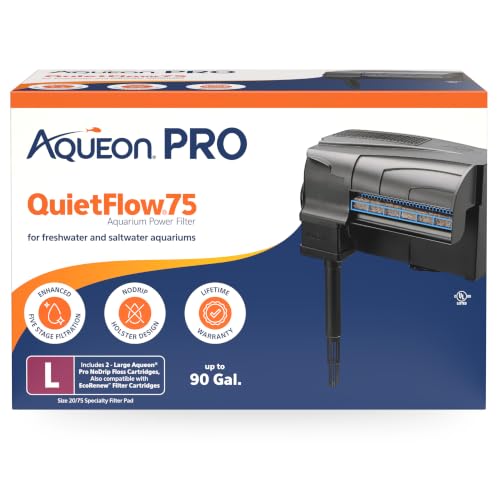
4. Aqueon QuietFlow 75 Aquarium Power Filter
Best for: Large freshwater community tanks
The Aqueon QuietFlow 75 LED PRO is a hang-on-back power filter rated for aquariums up to 90 gallons. It uses five filtration stages to handle particles, odors, toxins, and waste. Dense floss catches suspended debris, while activated carbon helps reduce odors and some dissolved impurities. The Bio-Holster and Bio-Media grid provide surfaces for beneficial bacteria, which support biological filtration.
A specialty pad slot lets you tailor the setup for specific water concerns. The filter works with both freshwater and saltwater tanks, giving it broader use than a basic freshwater-only model. Its cartridge and holster use a NoDrip design that helps limit spills during maintenance. The internal pump starts automatically without manual priming, then restarts after a restored power interruption. At around $61, it offers a sizable filtration system for larger tanks, though replacement media will add to the long-term cost.
Pros
- Five filtration stages combine floss, carbon, biological media, and a specialty pad.
- Auto-start pumping removes the need to manually prime the filter.
- NoDrip cartridge and holster design helps reduce water mess during maintenance.
Cons
- Rated for up to 90 gallons, so it may be excessive for smaller aquariums.
- Replacement cartridges and specialty media create ongoing maintenance costs.
3. Hang-On-Back Aquarium Filter with UV

Best for: Large tanks with green water
This hang-on-back aquarium filter is designed for 20- to 75-gallon fish tanks. It combines filtration, a surface skimmer, adjustable flow, and a built-in 5-watt UV chamber in one unit. The advertised 13-stage setup aims to handle cloudy water, floating debris, odors, and green water. At around $62, it costs more than a basic HOB filter, but it combines several tank-maintenance tools in one housing.
The isolated UV chamber keeps the 253.7nm UV light away from the bio-sponge, which helps protect beneficial bacteria. The manufacturer claims it can clear up to 99% of green water or algae growth, though results will depend on tank conditions and water quality. A waterfall-style return adds aeration, while the adjustable knob can reduce flow for shrimp or delicate fish. The unit works with freshwater and saltwater tanks, plus turtle, reptile, frog, and amphibian setups. Its noise rating is below 40dB, but the pump may make extra noise for about one minute during startup. Six months of support is included.
Pros
- Combines 13-stage filtration, UV treatment, surface skimming, and aeration.
- Adjustable flow suits large fish, delicate species, and shrimp.
- Isolated 5-watt UV chamber targets green water and tank odors.
Cons
- The surface skimmer requires the water level to sit above its fixed pipe.
- It may be oversized for tanks under 20 gallons and costs more than basic filters.
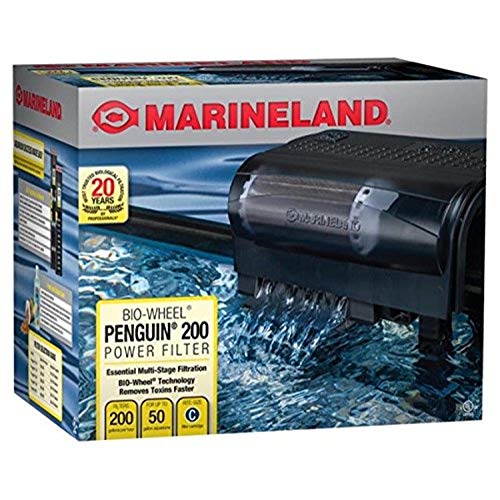
2. Marineland Bio-Wheel Penguin Aquarium Filter
Best for: Medium freshwater aquariums needing simple filtration
The Marineland Bio-Wheel Penguin 200 GPH is a hang-on-back power filter for aquarium owners who want several filtration stages in one unit. It moves up to 200 gallons of water per hour and combines mechanical, chemical, and biological filtration. Mechanical filtration catches visible debris, chemical filtration helps remove dissolved impurities, and biological filtration supports beneficial bacteria.
Its rotating Bio-Wheel is the main feature that sets this model apart. The wheel uses wet/dry biological filtration, allowing beneficial bacteria to grow on its surface as water passes over it. That design can support a more stable aquarium environment than mechanical filtration alone. The filter works with Marineland Rite-Size cartridges, so replacements are easy to identify. It costs around $41, though prices change. Marineland also sells this filter family in 75, 100, 150, 200, and 350 GPH versions, giving buyers more options for different tank sizes.
Pros
- Three-stage filtration handles debris, dissolved contaminants, and biological waste.
- Rotating Bio-Wheel provides dedicated wet/dry biological filtration.
- Five flow-rate options make it easier to match the filter to a tank.
Cons
- The 200 GPH model may be too powerful for small aquariums or delicate fish.
- It depends on Marineland Rite-Size cartridges, which limits media choices compared with filters that accept loose or custom media.
1. Hang-On-Back Aquarium Filter with UV Light

Best for: Large freshwater tanks with cloudy water
This hang-on-back filter is sized for 40- to 150-gallon aquariums. It combines mechanical, biological, chemical, and ultraviolet treatment in one unit. The package includes reusable activated carbon, ceramic balls, a filter sponge, and two filter socks. Around $85, it costs more than basic HOB filters, but the media set adds useful value for larger tanks.
The separate 7W UV chamber uses 253.7nm light to target green or yellow-green water, odors, and some suspended growth. Its isolated design keeps the UV section away from the bio-sponge area, which helps limit disruption to beneficial bacteria. A surface skimmer collects oil film and floating debris, while the waterfall return adds surface movement. The flow knob and telescopic intake pipe support different water levels and gentler currents for shrimp, turtles, frogs, and delicate fish. It works in freshwater or saltwater setups.
Pros
- The 7W, 253.7nm UV light targets green water, yellow water, and odors.
- Reusable carbon, ceramic balls, sponge, and two socks cover several filtration stages.
- Adjustable flow and a telescopic pipe fit different tanks and livestock needs.
Cons
- The unit is designed for 40- to 150-gallon tanks, so it may be too large for smaller aquariums.
- UV lamps need eventual replacement, and the clear-water results depend on proper cleaning and water flow.
Buying Guide
For a saltwater hang-on-back filter, prioritize adjustable, reliable flow. Marine tanks need steady circulation, and a unit rated too high can stress corals, while weak flow leaves waste behind.
- Flow rate: Aim for a published rate of 5–10 times the tank volume hourly. A 20-gallon tank generally needs 100–200 gallons per hour, with a dial to reduce output.
- Media space: Choose a chamber that holds mechanical and chemical media, such as a sponge and ½–1 cup of activated carbon. Replace or rinse media on schedule.
- Saltwater durability: Look for a plastic intake, sealed motor, and no exposed metal near the water. A ceramic impeller shaft can resist wear during continuous use.
- Tank fit: Measure the rim and rear clearance before buying. Many hang-on units need 3–5 inches behind the aquarium and a water level within the maker’s stated range.
- Maintenance and cost: Favor tool-free impeller access and an intake sponge. Budget roughly $40–$120, plus $5–$15 monthly for carbon, floss, or replacement sponges.
If you cannot get every feature, prioritize adjustable flow sized for your tank, since poor circulation can harm livestock faster than limited media capacity.
Frequently Asked Questions
How do I choose a hang-on-back filter for a saltwater aquarium?
Choose a hang-on-back filter with adjustable flow, saltwater-safe materials, and enough capacity for your tank’s actual volume. Look for space to replace disposable cartridges with sponge, filter floss, or carbon media. For a 20-gallon aquarium, a unit rated around 100 to 200 gallons per hour is a practical starting range.
What size HOB filter do I need for a marine tank?
Match the filter’s rated flow to roughly 5 to 10 times your aquarium’s volume per hour, then reduce flow if livestock dislikes strong circulation. A 30-gallon tank therefore needs about 150 to 300 gallons per hour, though manufacturer ratings can drop once media becomes dirty.
Can a hang-on-back filter support a reef aquarium?
Yes, a hang-on-back filter can support a saltwater tank, but it should not replace a protein skimmer or regular water changes. Use it for mechanical and chemical media, and clean its intake weekly. Carbon or phosphate-removing media can help, but follow the product’s recommended amount.
Are HOB filters safe for reef tanks?
Yes, HOB filters are safe for reef tanks when the intake is guarded and the return does not splash excessively. Check the water level daily because evaporation can expose the intake, especially on small open-top tanks. A pre-filter sponge also protects shrimp, snails, and small fish.
Conclusion
The Hang-On-Back Aquarium Filter with UV Light is the top pick for saltwater keepers who want added water movement and UV treatment in one compact unit. If your priority is quieter operation, easier media changes, or a lower purchase price, choose a simpler HOB model instead and put the savings toward quality filter media. Before buying, double-check the tank size, saltwater compatibility, included media quantity, replacement-media availability, and current price. Also confirm that the filter will fit the aquarium rim and leave enough room behind the tank for maintenance. A HOB filter can support clear water, but it does not replace regular water changes, proper circulation, or a reliable protein skimmer on larger marine systems.