
The Aqueon QuietFlow Internal Filter is the best filter for shrimp tank setups for most buyers because its adjustable flow supports gentler circulation in smaller aquariums. This internal power filter also combines mechanical, biological, and chemical filtration in one compact unit. Add a fine sponge over the intake to help protect baby shrimp.
This guide is for anyone setting up a nano tank, breeding shrimp, or replacing an oversized filter. The most important factors are tank size, flow control, and intake protection, since strong suction can pull in young shrimp. The five picks below are ranked with clear reasons and honest drawbacks for each, so you can match the filter to your aquarium and shrimp colony.
Quick Comparison
| # | Product | Best For | Price | |
|---|---|---|---|---|
| 1 | Aqueon QuietFlow Internal Filter | Quiet filtration for small tanks | ~$30 | View → |
| 2 | NICREW Slim Aquarium Filter | Space-saving planted aquarium setups | ~$13 | View → |
| 3 | Pawfly Corner Sponge Aquarium Filter | Gentle flow for shrimp tanks | ~$8 | View → |
| 4 | AQUANEAT 3-Pack Aquarium Bio Sponge Filter | Multi-tank sponge filtration needs | ~$7 | View → |
| 5 | AQUANEAT 6-Pack Aquarium Filter Pre-Filter Sponges | Protecting intakes from debris | ~$6 | View → |
5 Top Shrimp Tank Filter Picks
These five aquarium filters are ranked, counting down to the top pick.
5. AQUANEAT 6-Pack Aquarium Filter Pre-Filter Sponges

Best for: Shrimp and fry tank protection
The AQUANEAT 6-pack adds a foam barrier over aquarium filter intakes. Each sponge measures 3.2 by 1.8 inches, with an inner opening listed at 0.8 inches. Its elastic material can fit intake tubes from about 0.8 to 1 inch, or 20 to 25.4 mm. Check your filter’s diameter first, since this is not a universal cover.
These pre-filter sponges help stop baby fish, shrimp, and snails from entering hang-on-back, powerhead, or canister filters. They also catch larger debris, such as flake food, plant pieces, and loose waste, before it reaches the main filter media. The six pieces offer useful spares for replacement or multiple tanks. They arrive flattened inside a vacuum bag, then expand after unpacking and rinsing. The center hole is not open all the way through, so the intake needs to seat properly inside the sponge. Rinse the foam as needed for your aquarium’s biological load. Around $6, this pack costs little, but fit remains the key concern.
Pros
- Protects small shrimp, fry, and snails from filter intakes.
- Captures larger particles before they clog the main filter.
- Six reusable foam covers provide replacements for multiple tanks.
Cons
- The 0.8 to 1-inch fit will not suit larger or unusually shaped intakes.
- The blind center hole may make installation less straightforward on some filter tubes.
4. AQUANEAT 3-Pack Aquarium Bio Sponge Filter

Best for: Betta and fry tanks
The AQUANEAT pack includes three compact sponge filters for aquariums up to 10 gallons. Each unit measures 2 inches in diameter and 4.75 inches tall, so it fits small tanks, breeding setups, hospital tanks, and shrimp habitats. The soft sponge catches floating debris without pulling fish or fry into an intake. It also provides a surface for beneficial bacteria, supporting biological filtration alongside basic mechanical filtration.
Each filter connects to an airline and air pump. Its air chamber creates fine bubbles that help improve oxygen exchange while producing gentle water movement. That low current suits bettas, guppies, killifish, dwarf cichlids, and newly hatched fish. Cleaning is simple: remove the sponge, rinse it in used aquarium water, and squeeze out trapped debris. Around $7 for three filters, this is an inexpensive option for several nano tanks or spare setups. The small design does limit how much waste each sponge can hold before cleaning.
Pros
- Three filters cover multiple tanks or replacement needs.
- Gentle flow protects fry, shrimp, and bettas.
- Rinsable sponge supports mechanical and biological filtration.
Cons
- Requires a separate air pump and airline.
- The 10-gallon limit makes it unsuitable for larger or heavily stocked aquariums.
3. Pawfly Corner Sponge Aquarium Filter

Best for: Betta, fry, and shrimp keepers
The Pawfly is a compact, air-powered sponge filter for small fish tanks. It measures 3.1 inches wide by 3.3 inches tall and is rated for aquariums from 10 to 30 gallons. Its fine, layered sponge catches waste while providing surface area for biological filtration. The gentle intake suits bettas, shrimp, fry, and other small fish that may struggle with strong water flow. An air pump is required but not included.
This filter also includes bottom gravel and ceramic rings. The gravel can help absorb some unwanted substances, while the rings provide added space for beneficial bacteria. You can rearrange the sponge sections and filter media to match your tank’s fish load. The adjustable outlet tube lets you set the height, and its duck-billed opening creates extra bubbles for water oxygenation. Maintenance is simple, but it requires a schedule. Rinse the sponges every two to four weeks using removed aquarium water, never tap water. Replace the white sponge about every two to three months. Around $8, it offers a low-cost setup for lightly stocked tanks.
Pros
- Fine sponge layers trap debris without pulling in shrimp, fry, or small fish.
- Gravel and ceramic rings add extra filtration media in a small housing.
- Adjustable outlet height and bubble-producing port support gentle aeration.
Cons
- The air pump is not included, so the complete setup costs more than the filter alone.
- Its 10 to 30 gallon rating may not suit heavily stocked tanks or aquariums needing stronger mechanical filtration.
2. NICREW Slim Aquarium Filter

Best for: Shrimp and betta nano tanks
The NICREW Slim Aquarium Filter is a small internal filter designed for tanks up to 5 gallons. Its 3-watt motor moves up to 42 gallons per hour, giving small aquariums regular water circulation without taking up much space. The slim body should be less distracting in nano and pico setups than a larger hanging filter. Its adjustable flow also gives owners more control over water movement, which matters for bettas and shrimp that may struggle with strong currents.
This filter includes the main body, intake tube, extension tube, intake sponge, and filter cartridge, so no separate starter parts are listed as necessary. A patent-pending priming system helps the filter start more easily, while the auto-restart feature brings it back online after power returns. The claimed quiet operation suits bedrooms, desks, and living rooms. At around $13, it is a low-cost option for very small tanks, though the compact design also limits its capacity compared with larger filters.
Pros
- 42 GPH flow supports circulation in aquariums up to 5 gallons.
- Adjustable output can reduce current for shrimp and bettas.
- Included sponge, cartridge, tubes, and filter body simplify setup.
Cons
- The 5-gallon maximum makes it unsuitable for medium or large aquariums.
- A 3-watt compact filter has less filtration capacity than larger models, so heavily stocked tanks may need a stronger system.
1. Aqueon QuietFlow Internal Filter
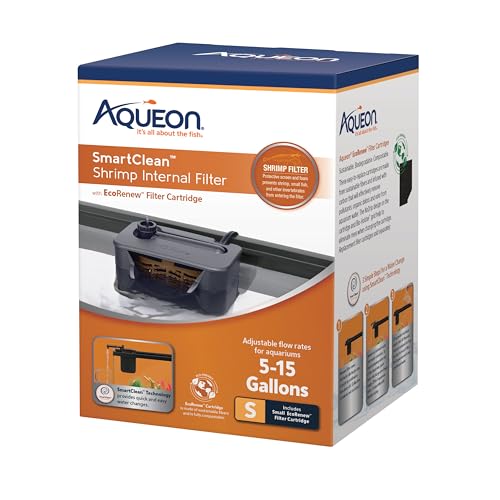
Best for: Small shrimp tanks, 5-15 gallons
The Aqueon QuietFlow Internal Filter is made for 5-15 gallon freshwater or saltwater aquariums. Its adjustable pump moves 35-75 gallons per hour, so you can reduce flow for shrimp and other small livestock. Suction cups or clips support installation inside the tank. The auto-start pump needs no manual priming and restarts after a power interruption.
Its intake grid and pre-filter foam help keep shrimp, fry, and debris out of the filter housing. A SmartClean water-change setup makes routine maintenance quicker, while the included EcoRenew cartridge uses biodegradable, compostable material. Aqueon recommends replacing the small cartridge every four weeks. Around $30, this filter offers useful protection for small inhabitants, but the ongoing cartridge cost adds up. The compact size also limits it to smaller aquariums.
Pros
- Protective grid and foam sponge reduce the chance of livestock entering the housing.
- Adjustable 35-75 GPH flow suits small freshwater or saltwater tanks.
- Auto-start operation removes the need for manual priming after outages.
Cons
- The 5-15 gallon rating excludes medium and large aquariums.
- The cartridge needs replacement every four weeks, creating a recurring supply cost.
Buying Guide
The most important factor is intake safety, because baby shrimp can fit through tiny openings. Choose a filter with a fine sponge prefilter or a fully enclosed intake.
- Intake protection: Select a sponge with pores around 20 to 40 PPI, or add a shrimp-safe prefilter that covers the entire intake tube. Secure it firmly so shrimp cannot slip behind it.
- Flow control: Look for adjustable output rather than a fixed current. For a 10-gallon aquarium, aim for gentle circulation near 40 to 100 gallons per hour, with the lowest setting suitable for newly hatched shrimp.
- Filter type: Air-driven sponge filters provide strong biological filtration and create little suction. Hang-on-back models can work, but they need an intake sponge and a baffle at the outflow.
- Tank fit: Match the model to the aquarium volume, then size up one range if the tank has heavy feeding or many shrimp. A dual-sponge unit suits many tanks from 10 to 20 gallons.
- Maintenance and cost: Choose a filter with replaceable sponges or washable media. Expect to spend about $10 to $30 for a dependable small setup, plus an air pump if needed.
If you cannot have everything, prioritize a fully protected intake over extra flow or advanced media.
Frequently Asked Questions
How do I choose a filter for a shrimp tank?
A sponge filter is usually the safest choice for a shrimp aquarium because it provides gentle flow and cannot pull shrimp into an intake. Choose a model rated for your tank size, then add an air pump and airline tubing. For a 10-gallon tank, a small or medium sponge filter usually fits.
What filter media is safest for shrimp?
A coarse sponge pre-filter is the safest intake protection for a shrimp tank, especially when babies are present. It blocks debris while allowing water through, and you can rinse it in removed tank water. Clean it every 2 to 4 weeks, or sooner if flow drops.
Can a hang-on-back filter be used with shrimp?
Yes, a hang-on-back filter can work for shrimp if its intake has a snug sponge guard and its outflow is gentle. The larger media chamber helps with biological filtration, but strong suction can trap shrimplets. Use a pre-filter rated for the intake and reduce flow with a valve or baffle.
Are air-driven sponge filters good for shrimp?
Yes, air-driven sponge filters are quiet, affordable, and well suited to shrimp because they create low current and provide grazing surfaces. They also need little maintenance beyond rinsing the sponge in old aquarium water. Replace the sponge only when it breaks down, often after 1 to 2 years.
Conclusion
Aqueon QuietFlow Internal Filter is the top pick for shrimp keepers who want a compact internal unit with simple placement and routine maintenance. If your priority is the gentlest possible intake and flow, choose a sponge filter instead, since its porous surface can offer added protection for small shrimp and shrimplets. Before buying, double-check the filter’s rated tank size, compatibility with your aquarium setup, how many units you need, and the current price. Also consider where the filter will sit, how much swimming space it uses, and whether replacement media is easy to find. A good aquarium filter should support clean water without creating strong currents or trapping livestock. Choose the model that fits your tank, stocking level, and maintenance habits.