
Hang-On-Back Aquarium Filter with UV Light is the top pick for most buyers seeking the best filter for 100 gallon fish tank. Its main advantage is added UV treatment without taking up space inside the aquarium. The HOB format also keeps installation simple, making it a practical choice for many large freshwater setups.
This guide is for aquarium owners choosing filtration for a 100-gallon tank, upgrading an older unit, or managing heavy fish loads. Focus on the filter’s rated flow, media capacity, and fit for your tank’s rim. A filter needs enough circulation to move water through its media without creating excessive current for fish. The six picks below are ranked by their key strengths, with clear reasons and honest drawbacks for each.
Quick Comparison
| # | Product | Best For | Price | |
|---|---|---|---|---|
| 1 | Hang-On-Back Aquarium Filter with UV Light | Small tanks needing UV clarity | ~$85 | View → |
| 2 | 600 GPH UV Aquarium Filter | High-flow large aquariums | ~$60 | View → |
| 3 | VEVOR 317GPH 4-Stage Canister Aquarium Filter | Multi-stage filtration seekers | ~$81 | View → |
| 4 | Submersible Aquarium Filter for 55–100 Gallon Tanks | Large tanks needing submersible circulation | ~$38 | View → |
| 5 | Marineland Penguin 450 Power Aquarium Filter | High-bioload community tanks | ~$95 | View → |
| 6 | Fluval 407 Canister Filter | Premium canister filtration setups | ~$255 | View → |
6 Top Filters for Large Fish Tanks
These six filters are ranked in order, counting down to the top pick for your 100-gallon aquarium.
6. Fluval 407 Canister Filter

Best for: Quiet 100-gallon community tanks
The Fluval 407 is an external canister filter designed for aquariums up to 100 gallons. Its eTEC pump delivers steady water movement and pressure, which helps remove suspended waste and keep the tank cleaner between maintenance sessions. Fluval also says the motor uses about the same energy as an LED light bulb, giving this filter a relatively low-power design for its size. At around $255, it targets aquarium owners who want strong filtration without moving up to a larger commercial-style unit.
The main advantage is its quieter operation. Fluval claims the pump runs up to 25% quieter than the previous version, which should appeal to people who keep aquariums in living rooms, bedrooms, or offices. The EZ-Lift media baskets also make routine service less awkward. A center handle lets you lift the stacked baskets with one finger, giving faster access to the filter media. Still, this is a sizable canister system. It needs hose routing, regular media cleaning, and space below or beside the aquarium. Setup also takes more work than using a small internal filter.
Pros
- Supports aquariums up to 100 gallons.
- Pump uses energy comparable to an LED bulb.
- EZ-Lift baskets provide quick, one-finger access.
Cons
- Large external design needs cabinet or floor space.
- Hose setup and routine media cleaning take time.
5. Marineland Penguin 450 Power Aquarium Filter
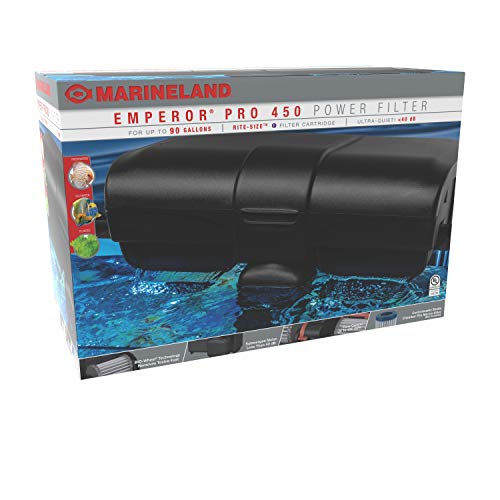
Best for: Large freshwater tanks needing biological filtration
The Marineland Bio-Wheel Penguin 450 GPH Power Aquarium Filter is designed for aquariums up to 90 gallons. Its adjustable flow reaches 450 gallons per hour, so you can match water movement to your tank and livestock. The filter uses Marineland Rite-Size E cartridges, which handle mechanical and chemical filtration. A rotating Bio-Wheel adds wet/dry biological filtration, giving beneficial bacteria a dedicated surface for processing aquarium waste.
The strongest feature is the range of six available sizes. The lineup includes models rated for 10, 20, 30, 50, 75, and 90 gallons, making it easier to choose a closer match than a single oversized filter. The 450 model suits larger tanks, but its rating is a maximum guideline rather than a guarantee for every aquarium setup. Around $95, it costs more than many basic power filters, so replacement cartridge costs should factor into the budget. The design also relies on compatible Rite-Size E cartridges, which limits your replacement options compared with filters that accept several cartridge shapes.
Pros
- Adjustable flow reaches 450 GPH, giving you control over water movement.
- Bio-Wheel technology adds wet/dry biological filtration for beneficial bacteria.
- Six sizes cover aquariums from 10 to 90 gallons.
Cons
- The 450 model may create excessive flow for some fish, plants, or smaller tanks.
- It requires Marineland Rite-Size E cartridges, limiting replacement flexibility.
4. Submersible Aquarium Filter for 55–100 Gallon Tanks

Best for: Large freshwater tanks with fish
This submersible internal filter is designed for aquariums from 55 to 100 gallons. It measures 15.3 inches tall and 3.14 inches wide with all sections attached. Removing one section reduces the height to 11.4 inches, which helps it fit smaller setups. The filter combines a reusable sponge with biological filtration, so it handles both debris and beneficial bacteria support. Its intake pulls water from the bottom, directing it through the filtration chambers instead of letting water bypass the system along the sides.
Around $38, it costs more than basic sponge filters but includes aeration through bubbles and water movement. The sponge sections are designed for long-term use, which can reduce recurring pad costs, though they still need periodic rinsing. The unit can also work in turtle habitats. A registered purchase includes a one-year warranty from the Manchester-based company. However, the maker says it is not suitable for small shrimp or infant fish, so community tanks need careful consideration.
Pros
- Covers a broad 55-to-100-gallon tank range.
- Detachable sections allow an 11.4-inch setup.
- Built-in aeration adds bubbles and surface movement.
Cons
- Not suitable for small shrimp or baby fish.
- Sponge media still requires cleaning, despite avoiding regular pad replacements.
3. VEVOR 317GPH 4-Stage Canister Aquarium Filter

Best for: 75- to 100-gallon freshwater tanks
The VEVOR Aquarium Filter is a submersible, four-stage canister filter for larger fish tanks and turtle setups. Its 12W pump moves up to 317 GPH, or 1,200 liters per hour, and the manufacturer recommends it for aquariums up to 100 gallons. Water passes through sponge layers, ceramic rings, and bio-balls before returning to the tank. At around $81, it costs less than many larger canister systems, though prices can change.
Several controls make this filter more flexible than a basic internal pump. The flow valve can reduce output, stop it, or leave it at maximum. Its UV lamp has 4-, 8-, and 24-hour timer settings, which gives you control over how often that feature runs. A pure copper brushless motor is rated below 50 decibels, while quick-release connections and thicker silicone seals should make routine cleaning less messy. The inlet also includes an oil-film removal feature. Still, the included media will need regular rinsing and replacement as waste builds up.
Pros
- Four filtration stages include sponges, ceramic rings, and bio-balls.
- Adjustable flow suits fish tanks and turtle enclosures.
- UV timer offers 4-, 8-, or 24-hour settings.
Cons
- The submersible housing takes space inside the aquarium.
- The 317 GPH rating may not provide enough turnover for heavily stocked 100-gallon tanks.
2. 600 GPH UV Aquarium Filter

Best for: Large tanks with green-water algae
This 14.5-by-3-by-3.1-inch aquarium filter is designed for 100- to 300-gallon tanks. It combines mechanical filtration, UV treatment, odor reduction, oxygenation, and water circulation in one unit. The 600 GPH flow rate suits larger setups with fish such as oscars, discus, rope fish, and bala sharks. Its membrane bags capture waste, while the UV lamp targets suspended algae and other microorganisms.
The manufacturer says green water may clear within 72 hours, though older or heavily affected tanks can take longer. A separate switch lets you disable the UV light while leaving filtration active, which helps when UV treatment is not needed. An adjustable air valve changes bubble size and water movement. At 9 watts, power use stays modest for a filter of this size. Around $60, it costs more than basic internal filters but adds UV and aeration in the same housing.
Pros
- 600 GPH circulation fits many 100- to 300-gallon aquariums.
- Independent UV control allows filtration without the lamp running.
- Adjustable bubbles improve oxygen exchange and surface movement.
Cons
- The 14.5-inch body may crowd smaller tanks or compact equipment areas.
- Algae removal is not instant, and older or heavily green water may need more than 72 hours.
1. Hang-On-Back Aquarium Filter with UV Light

Best for: 40–150-gallon tanks with green water
This hang-on-back filter is built for aquariums from 40 to 150 gallons. It combines mechanical, biological, chemical, and UV filtration in one unit. The package includes the main filter, a 7-watt UV light, reusable activated carbon, ceramic balls, a reusable sponge, and two reusable filter socks. Around $85, it offers a large media setup without requiring a separate UV sterilizer.
The UV chamber uses a 253.7nm wavelength and sits apart from the bio-sponge section. That layout helps limit direct UV exposure to beneficial bacteria. A surface skimmer pulls in floating debris and oil film, while the waterfall return adds surface movement. The flow knob and telescopic intake pipe help match different water levels and current needs. It supports freshwater and saltwater tanks, plus delicate fish, shrimp, turtles, and frogs when set to a gentler flow. The listing does not provide a UV lamp replacement schedule.
Pros
- Includes reusable carbon, ceramic balls, sponge, and two filter socks.
- Isolated 7W UV chamber targets green, yellow-green, and odorous water.
- Adjustable flow and telescopic piping suit varied tank setups.
Cons
- Its 40-gallon minimum makes it too large for many small aquariums.
- The listing does not state the UV bulb’s replacement interval or expected service life.
Buying Guide
The most important factor is real water turnover, because a 100-gallon aquarium needs enough circulation to remove waste without creating harsh currents. Choose a filter rated for roughly 400 to 600 gallons per hour, then adjust flow for your fish and plants.
- Flow rate: Look for a stated output of 400 to 600 GPH after media is installed. A filter rated at 500 GPH gives about five turnovers per hour, but clogged media can lower that figure.
- Media capacity: Favor a canister or large hang-on-back unit with space for at least 2 to 4 liters of biological media, plus separate mechanical and chemical sections.
- Tank compatibility: Confirm the model lists 100 gallons or more. For a heavily stocked tank, choose a unit rated for 125 to 150 gallons rather than relying on the minimum label.
- Maintenance needs: Pick a design with removable baskets, a prefilter sponge, and shutoff valves. Plan to rinse mechanical media every 1 to 2 weeks and replace carbon monthly if you use it.
- Noise and backup: Check for adjustable flow and a manufacturer noise claim below 40 dB when available. A spare air-driven sponge filter adds backup during power or equipment failures.
If you can prioritize only one factor, choose suitable flow with ample media space.
Frequently Asked Questions
How much filtration does a 100-gallon aquarium need?
For most 100-gallon tanks, choose a filter rated for at least 400 to 600 gallons per hour, with extra capacity for heavily stocked setups. That target provides roughly four to six water turnovers per hour, while the tank’s fish load and media size still matter.
What type of filter is best for a 100-gallon fish tank?
A canister filter is usually the strongest all-around choice for a 100-gallon fish tank because it offers strong mechanical and biological filtration in one unit. Look for a model with multiple media baskets, such as three or more, and check its flow rate after media is installed.
Can one filter handle a 100-gallon aquarium?
One properly sized filter can handle a 100-gallon tank, but two smaller units often provide better circulation and backup if one stops. For example, two filters rated around 250 to 350 gallons per hour each can spread intake and outlet flow across the aquarium.
Are hang-on-back filters suitable for a 100-gallon tank?
Hang-on-back filters can work on a 100-gallon aquarium if their rated flow and media capacity match the bioload, but they may offer less media space than a canister. Choose a unit rated around 500 to 700 gallons per hour, then reduce flow for delicate fish if needed.
Conclusion
The top recommendation is the Hang-On-Back Aquarium Filter with UV Light, best suited to aquarists who want strong circulation, added water clarity, and simpler access for routine maintenance. If your priority is maximum biological capacity for a heavily stocked 100-gallon aquarium, choose a large canister filter instead, since its media space and enclosed design can support more demanding setups with less equipment visible inside the tank. Before buying, double-check the filter’s rated tank size, compatibility with your aquarium’s rim and available clearance, the quantity included in the package, and the current price, since listings can change and one unit may not provide enough flow for your fish load.