
Fishkeeper Canister Filter is the top pick for most buyers because it offers a practical balance of strong filtration and manageable maintenance. If you need the best canister filter for 100 gallon tank, this model is a sensible place to start. Its external design keeps equipment out of the display, while layered media can support mechanical, biological, and chemical filtration when configured correctly.
This guide is for fishkeepers setting up, upgrading, or replacing filtration on a 100-gallon aquarium. The key details are rated tank capacity, flow rate, hose and basket design, and how easily you can remove and clean the media. A filter can move plenty of water yet perform poorly if its intake clogs or its seals are awkward to service. The five picks below are ranked by practical value, with clear reasons and honest drawbacks for each. That makes it easier to match the filter to your fish, plants, and maintenance routine.
Quick Comparison
| # | Product | Best For | Price | |
|---|---|---|---|---|
| 1 | fishkeeper Canister Filter | Budget-Conscious Aquarium Keepers | ~$86 | View → |
| 2 | VEVOR 317GPH 4-Stage Aquarium Canister Filter | Medium Freshwater Tank Owners | ~$81 | View → |
| 3 | Marineland Magniflow Canister Aquarium Filter | Easy-Maintenance Aquarium Hobbyists | ~$216 | View → |
| 4 | Aqueon QuietFlow Canister Aquarium Filter | Noise-Sensitive Fishkeepers | ~$250 | View → |
| 5 | Fluval 407 Canister Filter | Larger Aquarium Owners | ~$255 | View → |
5 Top Canister Filters for Large Aquariums
This list is ranked from fifth place to the top pick, based on tank capacity, filtration features, and overall value.
5. Fluval 407 Canister Filter

Best for: Large freshwater aquariums needing quiet filtration
The Fluval 407 is a canister filter designed for aquariums up to 100 gallons. Its eTEC pump provides steady water flow and pressure, while using about the same energy as an LED light bulb. That combination suits larger tanks where dependable circulation matters, without adding much noise to the room.
Fluval says the updated pump runs up to 25% quieter than the previous version. That could make a difference in living rooms, bedrooms, or office spaces. The EZ-Lift media baskets also simplify maintenance. A center handle lets you remove the stacked baskets with one finger, giving you quicker access to filter media. At around $255, this is a sizable purchase, but it offers useful convenience for fish keepers who want a high-capacity external filter.
Pros
- Handles aquariums up to 100 gallons, making it suitable for larger tanks.
- Uses eTEC pump technology for consistent flow and pressure.
- EZ-Lift baskets can be removed with one finger for easier cleaning.
Cons
- Around $255, it costs more than many basic hang-on-back filters.
- Canister filters need regular media cleaning and hose maintenance, which takes more effort than simpler filter types.
4. Aqueon QuietFlow Canister Aquarium Filter
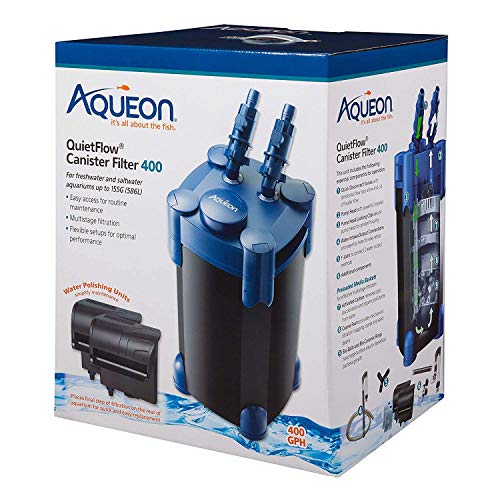
Best for: Large freshwater and community tanks
The Aqueon QuietFlow Canister Aquarium Filter is an external filtration system rated for aquariums up to 150 gallons. It combines mechanical, chemical, and biological filtration in one unit. Included media includes coarse foam, activated carbon, bio-balls, and bio-ceramic rings. Quick-disconnect valves, pump-locking heads, and dedicated water connections simplify access to the canister during maintenance. Hoses are included, so buyers do not need to build the plumbing setup separately.
Its strongest feature is the choice of water returns. You can use the spray bar, water director, or hang-on-back polishing unit to suit different aquarium layouts and flow needs. The polishing unit uses large Aqueon replacement cartridges, which the instructions call for replacing monthly. Carbon also needs a 30-day change schedule, while the foam pad can be rinsed or replaced as needed. The white polishing pad also needs replacement when dirty. At around $250, this filter targets owners who need high-capacity filtration, not buyers outfitting a small tank on a tight budget.
Pros
- Supports aquariums up to 150 gallons with four types of included filter media.
- Offers three water-return options, including a spray bar and polishing unit.
- Quick-disconnect valves and locking pump heads make routine access easier.
Cons
- Monthly carbon and polishing-cartridge changes add recurring maintenance and supply costs.
- Its size, hose setup, and around-$250 price may be excessive for smaller aquariums.
3. Marineland Magniflow Canister Aquarium Filter

Best for: Large freshwater or saltwater aquariums
The Marineland Magniflow 400 GPH is an external canister filter for aquariums up to 100 gallons. It supports freshwater and saltwater setups, with water moving through three filtration stages. Mechanical foam catches debris, activated carbon helps remove odors and impurities, and biological media provides surfaces for beneficial bacteria. The Stack N’ Flo tray design directs water through each layer.
Several media types come included: filter foam, activated carbon bags, bio-filter balls, ceramic rings, and polishing pads. That gives buyers a usable setup without purchasing every filter layer separately. A quick-prime button fills the chamber for startup, while the sealed lid lifts off when the media needs attention. It also accepts Marineland Rite-Size T media. At around $216, this filter costs more than many basic hang-on-back models, but its enclosed design keeps equipment outside the tank and supports higher-capacity aquariums.
Pros
- 400 GPH flow supports aquariums up to 100 gallons.
- Three-stage filtration handles debris, chemical impurities, and biological waste.
- Included foam, carbon, ceramic rings, and polishing pads reduce setup costs.
Cons
- The 400 GPH flow may be too strong for small tanks or gentle-flow fish.
- Canister maintenance requires disconnecting hoses and opening the sealed lid.
2. VEVOR 317GPH 4-Stage Aquarium Canister Filter

Best for: 75- to 100-gallon freshwater tanks
The VEVOR 317GPH canister filter is made for larger aquariums, turtle habitats, and display tanks. Its 12W pump moves up to 1,200 liters per hour, with a flow valve that can reduce or stop circulation. The four-stage setup uses sponges, ceramic rings, and bio-balls to trap debris and support biological filtration. Around $81, it costs less than many larger canister systems.
Its built-in UV lamp adds another water-treatment step, and the timer offers 4-, 8-, or 24-hour settings. The copper brushless motor is rated below 50 decibels, which should suit living rooms and bedrooms better than louder air-driven equipment. Quick-release connections and silicone sealing rings simplify removal while helping limit leaks. The inlet also includes an oil-film removal feature for better surface circulation. Still, the 317GPH rating is a maximum. Media buildup and hose routing can reduce actual flow.
Pros
- Four filtration stages combine mechanical sponges with ceramic rings and bio-balls.
- Adjustable flow control can run at full, reduced, or zero output.
- UV timer settings let owners choose 4, 8, or 24 hours.
Cons
- The 317GPH maximum may provide less circulation once media becomes dirty.
- Canister filters require regular cleaning of sponges, hoses, seals, and the rotor.
1. fishkeeper Canister Filter
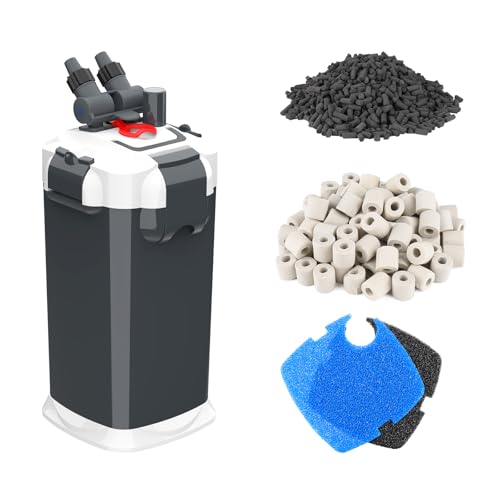
Best for: Mid-size freshwater and saltwater aquariums
The fishkeeper 390GPH is a three-stage canister filter designed for aquarium water circulation and mechanical, chemical, and biological filtration. Its motor can move up to 390 gallons per hour, while the adjustable flow valve lets you reduce output for tanks with slower-moving fish or delicate plants. The unit is listed for freshwater and saltwater aquariums.
Its copper brushless motor is designed to reduce operating noise and energy use. That may appeal to people who keep an aquarium in a bedroom, office, or living room, though actual sound levels can vary with setup and maintenance. The included manual covers installation and troubleshooting, which should make the first setup less confusing. At around $86, it offers a three-stage design without moving into premium pricing. Still, buyers should confirm that the included filter media matches their water-care routine before purchase.
Pros
- Adjustable flow control helps match circulation to different fish, plants, and tank setups.
- Three filtration stages provide separate space for removing debris and treating aquarium water.
- Brushless copper motor is designed for quieter, lower-energy operation.
Cons
- A 390 GPH rating may create too much current for very small tanks or slow-moving species.
- Canister filters require regular media cleaning and hose maintenance, which takes more work than many internal filters.
Buying Guide
Choose a canister with enough real-world flow for your aquarium’s size. A 100-gallon setup usually needs 400 to 600 GPH after media, hoses, and lift reduce the advertised rate.
- Flow rate: Look for a listed maximum of about 600 to 900 GPH, since many units lose 20% to 40% after media installation. Heavily stocked tanks may need stronger circulation.
- Media capacity: Choose at least 6 liters of basket space, with separate trays for coarse sponge, fine floss, and biological media. Larger media chambers reduce cleaning frequency.
- Hose and lift: A 5/8-inch or 3/4-inch hose works well for large aquariums. Confirm the pump can move water 4 to 5 feet from the cabinet to the tank rim.
- Maintenance design: Look for double shutoff valves, a self-priming button, and removable baskets. Plan to rinse mechanical sponges every 2 to 4 weeks and replace fine floss as needed.
- Operating cost: Compare power use, seal kits, hoses, and replacement impellers. A suitable unit often costs $150 to $350, while parts may add $20 to $60 each year.
If you cannot have everything, prioritize usable flow after media, because weak circulation can leave waste in the tank.
Frequently Asked Questions
How powerful should a canister filter be for a 100-gallon aquarium?
For a 100-gallon aquarium, choose a canister filter rated for at least 100 gallons, with a target flow of about 600 to 1,000 gallons per hour before media and tubing reduce output. A larger unit with adjustable flow gives more headroom and may need cleaning every two to four weeks in a heavily stocked tank.
What features matter most in a canister filter for large tanks?
The most useful features are adjustable flow, multiple media baskets, strong seals, and easy access for cleaning. Look for three or four baskets so mechanical, biological, and chemical media can stay separated. A priming button, shutoff valves, and a spray bar also make a large aquarium easier to maintain.
Can a single canister filter handle a 100-gallon tank?
Yes, one properly sized canister can handle a 100-gallon aquarium if its actual flow, media capacity, and maintenance schedule match the livestock load. Choose a model rated above the tank size, such as a 125- or 150-gallon unit, when fish produce heavy waste or the tank has dense décor.
Are two smaller filters better than one large canister for a 100-gallon aquarium?
Two smaller filters can be better when you want backup circulation, easier cleaning, or separate media types. For example, two units rated around 75 gallons each provide coverage if one stops, but they cost more, use extra power, and require twice as many hoses and replacement parts.
Conclusion
Fishkeeper Canister Filter remains the top recommendation for large-tank owners who want a practical, general-purpose filter for a 100-gallon aquarium. If your priority is maximum water movement or a heavier bioload, choose a higher-capacity canister instead, since extra filtration room can reduce maintenance pressure. Before buying, double-check the listed tank size, hose and inlet compatibility, the quantity included, and the current price. Capacity ratings can vary by brand, and advertised flow often drops after hoses, media, and intake guards are installed. Plan space beside the aquarium, too, because canisters need room for tubing and routine cleaning. Match the media layout to your fish, plants, and feeding habits. A good filter should fit your setup, budget, and maintenance routine.