
The Kirecoo Aquarium Algae Scraper is the best aquarium algae scraper for most buyers because its multi-tool design handles more than one cleaning job. It combines a firm scraper with softer cleaning tools, so routine glass care does not require several separate gadgets. That makes it a practical choice for freshwater tanks and regular maintenance.
This guide is for aquarium owners who want cleaner glass without reaching into the tank. The most important factors are scraper material, handle length, tool coverage, and how safely each head works near silicone seams. A metal blade may remove stubborn growth faster, while plastic or sponge heads suit lighter buildup. The 7 picks below are ranked with clear reasons and honest drawbacks for each, so you can match the cleaner to your tank size and algae problem.
Quick Comparison
| # | Product | Best For | Price | |
|---|---|---|---|---|
| 1 | Kirecoo Aquarium Algae Scraper | Small Glass Aquarium Owners | ~$8 | View → |
| 2 | Carefree Fish 4-in-1 Aquarium Cleaning Tools | Owners Needing Multi-Tool Cleaning | ~$14 | View → |
| 3 | Aqueon Magnetic Aquarium Algae Scraper | Scratch-Conscious Rimmed Tank Owners | ~$15 | View → |
| 4 | hygger 6-in-1 Aquarium Cleaning Tool Kit | Aquarists Wanting One Complete Kit | ~$23 | View → |
| 5 | Pronetcus Aquarium Algae Scraper | Routine Algae Removal On A Budget | ~$13 | View → |
| 6 | Ymiueip Algae Scraper | Narrow-Tank Corner Cleaning | ~$7 | View → |
| 7 | QANVEE Aquarium Algae Scraper Brush | Brush-Focused Freshwater Tank Care | ~$16 | View → |
7 Top Aquarium Algae Scraper Picks
This ranked list counts down from capable algae scrapers to the aquarium cleaning tool we consider the strongest overall pick.
7. QANVEE Aquarium Algae Scraper Brush

Best for: Freshwater and reef tank owners
The QANVEE aquarium scraper uses a wide stainless steel blade to remove algae from glass tank walls. It includes 10 blades and a 26-inch handle, giving you more reach than a short handheld brush. The handle adjusts to 15, 20, or 26 inches, so it can fit smaller tanks or deeper aquariums. Around $16, it costs less than many powered cleaning tools.
Its aluminum-magnesium alloy shaft keeps the cleaner fairly light, while the ABS plastic head adds structure around the blade. The included cover lets you use the tool as a gravel spatula when the blade is protected. The blade is described as glass-friendly, but grit trapped between the scraper and glass can still cause scratches. Use light pressure and rinse the blade before each pass. This cleaner suits routine algae removal, though it may feel less convenient in tanks with dense plants, rocks, or curved panels.
Pros
- Three handle lengths, 15, 20, and 26 inches, suit different aquarium depths.
- Ten stainless steel blades provide replacements for future cleaning sessions.
- A protective cover allows the head to work as a gravel spatula.
Cons
- Stainless steel blades require careful handling around sand, gravel, seals, and tank decorations.
- The rigid scraper head may not reach algae in tight corners or around thick plant growth.
6. Ymiueip Algae Scraper

Best for: Tall freshwater and saltwater tanks
The Ymiueip algae scraper is a long-handled glass aquarium cleaner with a 25-inch reach. It removes green algae, brown algae, calcium buildup, moss, and other residue without putting your hands in the water. The package includes 10 blades, and the blade can be replaced when it becomes dull. Stainless steel construction helps the shaft and scraper resist rust in freshwater or saltwater setups.
A wide blade covers more glass per pass than a narrow razor tool, which can shorten routine cleaning. The scraper comes in two sizes, so buyers can choose a version suited to a smaller or larger tank. The listed details do not specify the exact dimensions of both options. Its protective sheath covers the blade during storage. Attached to the scraper, that cover also works as a basic substrate leveler for smoothing sand or gravel around plants. At around $7, it offers useful reach and spare blades for little money. Still, this is a manual tool, not a quick magnetic cleaner.
Pros
- 25-inch reach helps clean deep tanks while keeping hands dry.
- Includes 10 blades, with replaceable blades for continued use.
- Sheath protects the edge and can level aquarium substrate.
Cons
- A metal razor needs careful handling and may damage acrylic or plastic panels.
- The wide blade may be awkward around plants, hardscape, and tight corners.
5. Pronetcus Aquarium Algae Scraper

Best for: Regular aquarium glass cleaning
The Pronetcus algae scraper is a manual tool for removing algae from freshwater and saltwater aquarium glass. It uses a stainless steel blade and includes 10 replaceable blades, giving fish keepers spares for future maintenance. The large scraper head covers more glass with each pass than a small handheld pad, which can help with broad viewing panels.
A plastic blade cover provides safer storage between cleanings and helps protect the exposed edge when the tool is not in use. Blade replacement is designed to be straightforward, although users should handle each stainless steel blade carefully. The scraper costs around $13, so it offers a low-cost option for tanks that need frequent glass cleaning. Buyers must select the correct scraper length for their aquarium height. Extra replacement blades are available separately under product code B08ZHJ5FLB.
Pros
- Includes 10 stainless steel replacement blades for repeated maintenance.
- Large head can remove algae across wider glass panels.
- Plastic blade cover supports safer storage after use.
Cons
- The listing does not provide scraper length options here, so buyers must confirm the size before ordering.
- Metal blades can scratch aquarium glass if grit gets caught underneath or the tool is used carelessly.
4. hygger 6-in-1 Aquarium Cleaning Tool Kit

Best for: Deep tanks and hands-off cleaning
The hygger 6-in-1 aquarium cleaning kit combines six attachments with one telescoping handle. You get a gravel rake, stainless steel algae scraper, flat sponge, right-angle sponge, tube brush, and fish net. The tool fits both freshwater and saltwater setups, and the handle keeps your hands out of the water during routine maintenance. At around $23, it offers several cleaning tools in one package.
The carbon fiber composite handle adjusts from 19.7 to 35.4 inches, which suits tanks up to about 2.65 feet deep. Its threaded sections are designed to stay tight, while the spring closure helps keep attachments secure. The scraper targets stuck-on buildup, the sponges handle glass and substrate, and the angled pad reaches corners. The tube brush also helps clean hoses and narrow areas. Replacement sponges and scraper blades are listed under ASIN B081SRY68V, though buyers should check current availability.
Pros
- Six interchangeable tools cover algae, gravel, glass, hoses, corners, and fish removal.
- The 19.7-to-35.4-inch handle works for many deep tanks without wet hands.
- Spring closures help hold each attachment firmly during cleaning.
Cons
- The handle length may not reach tanks deeper than about 2.65 feet.
- A metal scraper requires care on acrylic surfaces, since rough use can cause scratches.
3. Aqueon Magnetic Aquarium Algae Scraper
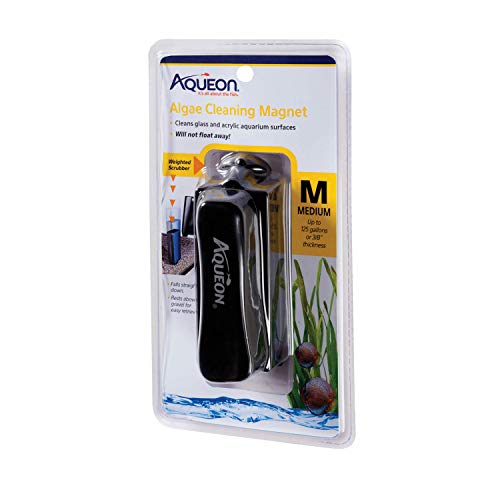
Best for: Small to medium home aquariums
The Aqueon Aquarium Algae Scraper is a medium magnetic cleaner for glass and acrylic fish tanks. Its outside magnet moves the inside scrubber, so you can remove algae without putting your hand in the water. The cleaning pad measures 3.75 inches high by 1.5 inches wide, which suits routine cleaning on smaller tank panels.
The curved pad can follow both flat and curved surfaces. Its weighted scrubber stays down instead of floating away, which makes it easier to reposition after each pass. If the two magnetic pieces separate, the inside section drops straight down for retrieval rather than drifting across the tank. That feature can save time, especially in deeper aquariums. At around $15, it costs less than many larger magnetic cleaners, though the compact pad may require several passes on wide glass panels.
Pros
- Cleans aquarium walls from outside the tank with a magnetic design.
- Curved pad works across flat and rounded glass or acrylic surfaces.
- Weighted interior piece drops for easier retrieval if the magnets separate.
Cons
- The 1.5-inch-wide pad covers a limited area, so large tanks may take longer to clean.
- It may not remove thick, hardened algae as quickly as a larger scraper or blade tool.
2. Carefree Fish 4-in-1 Aquarium Cleaning Tools

Best for: Deep freshwater and saltwater aquariums
The Carefree Fish 4IN1 Aquarium Cleaning Tools set combines four maintenance tools in one long-handle kit. It includes an algae scraper, sponge brush, tubing brush, and fish net. The fiberglass pole feels light, resists aging, and has an insulated surface for use near aquarium equipment. Its smooth finish also gives algae and limescale fewer places to cling.
The telescopic handle adjusts from 18 to 24 inches, so it suits tanks with water depths up to 24 inches. Interchangeable heads can be changed in seconds and rinsed after use. The scraper uses replaceable inserts for stubborn buildup, but spare inserts are not included. Around $14, this set offers useful coverage for routine freshwater or saltwater care. Dry each part thoroughly after cleaning to help extend its service life. The scraper is not suitable for acrylic tanks, so check your aquarium material first.
Pros
- Four tools cover algae removal, glass cleaning, tubing, and fish catching.
- Fiberglass construction keeps the handle light, sturdy, and insulated.
- Adjustable 18-to-24-inch length reaches tanks with deeper water.
Cons
- The scraper cannot be used on acrylic aquariums because it may damage the surface.
- Replacement scraper inserts cost extra, and no spare insert comes with the kit.
1. Kirecoo Aquarium Algae Scraper

Best for: Large glass aquariums with stubborn algae
The Kirecoo aquarium scraper uses a stainless steel head, handle, and replaceable blades to remove algae from glass tanks. It includes 10 blades, making it a practical low-cost option for regular maintenance. The handle reaches 25.6 inches with the extension attached, or 18.1 inches without it. That range suits many tank sizes while keeping your hands above the water.
Its strongest feature is the right-angle head. It can reach along tank edges and into corners that flat scrapers often miss. Holes in the head let water pass through, which reduces drag during underwater use. Installation requires no tools. Screw the handle sections together, place a blade between the head and stainless steel plate, then tighten the two large screws. At around $8, it costs little to keep spare blades available. Still, the sharp edge needs careful handling around silicone seals and tank corners.
Pros
- Stainless steel construction resists rust in freshwater and saltwater tanks.
- 25.6-inch maximum reach helps clean deep aquariums without wet hands.
- Right-angle head reaches edges, corners, and other hard-to-clean areas.
Cons
- Sharp blades can cut or crack silicone sealant if used carelessly.
- Blade changes require handling exposed edges and tightening two screws.
Buying Guide
The most important factor is surface compatibility. A scraper made for glass can scratch acrylic, while a soft plastic pad may struggle with hard, crusty algae.
- Tank material: Choose a plastic blade or pad for acrylic tanks. Stainless steel blades suit glass only, and they should never touch silicone seams.
- Reach: Match the handle to tank depth. A 12- to 18-inch handle fits many small and medium aquariums, while tanks deeper than 20 inches need an extension.
- Blade width: Pick a 2- to 4-inch head for most tanks. Wider heads clear flat panels faster, but a 1- to 2-inch edge works better near corners and decorations.
- Replacement parts: Look for models with replacement blades or pads sold in packs of 2 or more. A scraper that accepts standard refills costs less to maintain.
- Magnet or handle design: Magnetic cleaners work well on shallow tanks, but check the stated glass thickness, often up to 1/2 inch. For thick glass, tall tanks, or heavy algae, choose a fixed-handle tool.
If you cannot have everything, prioritize surface compatibility to prevent permanent scratches.
Frequently Asked Questions
How do I choose an algae scraper for my aquarium?
Choose an algae scraper based on your tank’s glass or acrylic panels, algae type, and reach needed. Magnetic models suit regular glass cleaning, while plastic blades work better for acrylic surfaces. For a 20-gallon tank, a scraper with a 24-inch handle can reach the bottom without soaking your arm.
What type of aquarium algae scraper works best for acrylic tanks?
A plastic-blade or soft-pad scraper is safest for acrylic aquariums because it reduces scratch risk. Avoid metal razor blades unless the manufacturer specifically approves them. For example, a six-inch plastic blade can remove film algae from flat panels, but stubborn spots may need several gentle passes.
Can a magnetic aquarium cleaner remove tough algae?
A magnetic aquarium cleaner can remove light to moderate algae, but it may struggle with thick growth and hard deposits. Choose one rated for your glass thickness and tank size. A strong model may clean 10-millimeter glass, while a smaller unit can lose contact or trap sand beneath the pad.
Are razor-blade aquarium scrapers safe for every tank?
Razor-blade aquarium scrapers are safe for standard glass tanks when used carefully, but they can scratch acrylic and silicone seams. Keep the blade flat and replace it when rusty or dull. A 45-degree angle helps lift buildup from glass, yet extra care is needed near corners and seals.
Conclusion
Kirecoo Aquarium Algae Scraper is the top recommendation for aquarium owners who want a practical, multi-use tool for routine glass cleaning and light algae buildup. If your priority is reaching deep corners or working around delicate plants, choose a scraper with a narrower head, softer pad, or longer handle instead. Before buying, double-check the blade or pad size, tank compatibility, included quantity, and current price, since listings can change and some kits suit only certain glass or acrylic surfaces. Match the tool to your aquarium’s material and layout, then consider how often algae returns and how much storage space you have. A simple fit usually matters more than extra attachments.