
For most buyers, the Hygger Aquarium Double Sponge Filter (M) is the best aquarium filter for axolotl because its gentle, air-driven design provides filtration without the strong current these animals often dislike. Its twin sponge setup also gives beneficial bacteria more room to grow, while the open design makes routine rinsing straightforward.
This guide is for axolotl keepers choosing a first filter, replacing a noisy unit, or setting up a new tank. The key checks are aquarium size, water flow, and whether your air pump can run the filter at a steady rate. Sponge material and access for cleaning also affect long-term upkeep. The five picks below are ranked with clear reasons and honest drawbacks for each, so you can match a filter to your tank and care routine.
Quick Comparison
| # | Product | Best For | Price | |
|---|---|---|---|---|
| 1 | Hygger Aquarium Double Sponge Filter (M) | Shrimp Keepers With Medium Tanks | ~$20 | View → |
| 2 | Marineland Penguin 200 Bio-Wheel Aquarium Filter | Freshwater Tanks Needing Bio-Wheel Filtration | ~$41 | View → |
| 3 | Tetra Whisper IQ Power Filter | Noise-Sensitive Community Aquarium Owners | ~$23 | View → |
| 4 | Turtle Tank Aquarium Filter | Turtle Habitats With Heavy Waste | ~$40 | View → |
| 5 | DEGGOX Aquarium Electric Power Sponge Filter | Small Tanks Needing Powered Sponge Filtration | ~$30 | View → |
5 Aquarium Filters for Axolotls
This ranked list counts down from the fifth option to our top pick, with flow, capacity, and tank size in mind.
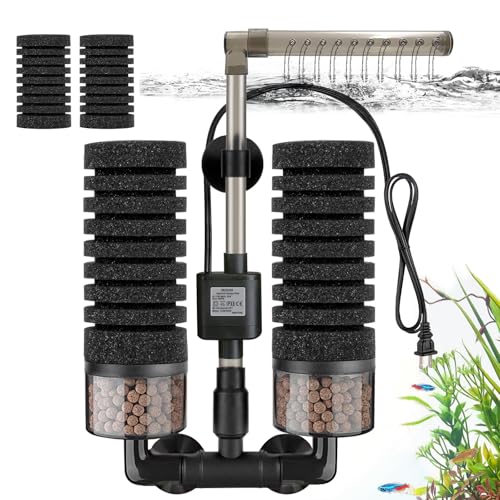
5. DEGGOX Aquarium Electric Power Sponge Filter
Best for: Low-flow fry and shrimp tanks
This DEGGOX electric sponge filter combines a submersible pump with physical and biological filtration. It is rated for aquariums from 20 to 55 gallons, and it works without a separate air pump. Plug it into a power source, then adjust the output with the venturi nozzle or rain mode. The slower flow suits fry, shrimp, snails, bettas, and other small fish that may struggle with strong current.
The filter uses detachable fine sponges to catch small particles, while the included ceramic media balls provide space for beneficial bacteria. Its reusable parts should not need frequent replacement, and the materials are listed as safe for freshwater and saltwater setups. Around $30, it offers a practical setup for larger tanks that need gentle circulation. The main concern is package clarity. The product title mentions two spare sponges, while the feature list says four, so confirm the included count before ordering.
Pros
- Runs from its built-in pump, so no extra air pump is required.
- Venturi and rain settings provide gentler flow for fry, shrimp, and bettas.
- Combines reusable sponge filtration with ceramic biological media.
Cons
- The stated replacement-sponge count is inconsistent, with two in the title and four in the feature list.
- A sponge filter takes up space inside the aquarium and may need regular rinsing as debris builds up.
4. Turtle Tank Aquarium Filter

Best for: Large turtle and fish tanks
This adjustable aquarium filter is designed for 20- to 75-gallon tanks. Its pump moves up to 290 gallons per hour, with a flow control that lets owners reduce the current when needed. The filter works in freshwater and saltwater setups, including turtle tanks, fish tanks, and habitats for frogs or other amphibians. It can operate with water as low as 2.6 inches, which helps in shallow turtle enclosures.
Filtration combines a dense, double-sided mesh sponge with ceramic bio-balls. The sponge catches waste, uneaten food, leaves, and fine particles. The ceramic media adds porous surface area for beneficial bacteria, which help process aquarium waste and reduce odor or discoloration. A top-access canister makes media cleaning and replacement easier, while the waterfall outlet adds surface movement and aeration. Around $40, it offers useful capacity for larger enclosures, but buyers should confirm that the housing fits their tank.
Pros
- Adjustable flow lets you tailor circulation for fish, turtles, or amphibians.
- The mesh sponge traps visible debris and fine particles before they spread.
- Ceramic bio-balls support biological filtration and waste breakdown.
Cons
- The 290 GPH pump may create too much current for small or slow-moving animals, even at a reduced setting.
- Its 20- to 75-gallon range and large filter housing may take up substantial space in smaller tanks.
3. Tetra Whisper IQ Power Filter

Best for: Quiet 20-gallon freshwater setups
The Tetra Whisper IQ 130 GPH Power Filter is a hang-on-back filter for aquariums up to 20 gallons. Its submerged motor starts without manual priming, which simplifies setup after cleaning or a power outage. Water moves at up to 130 gallons per hour, giving small tanks steady mechanical and biological filtration. At around $23, it sits in the budget range for compact aquarium equipment.
The sound shield keeps rated noise below 40 dB, so it may suit bedrooms, offices, and living rooms. Its Stay Clean system is designed to help maintain healthier pH conditions and reduce maintenance demands. The filter uses large Tetra Whisper Bio-Bag cartridges, which should be replaced about once a month. Those refills cost extra, so the long-term price is higher than the initial purchase. The design also needs enough tank clearance for a hang-on-back unit.
Pros
- Self-priming motor starts automatically after installation or power interruptions.
- 130 GPH flow suits aquariums up to 20 gallons.
- Sound shield limits rated operating noise to less than 40 dB.
Cons
- Large Bio-Bag cartridges need monthly replacement and are sold separately.
- The 20-gallon capacity limits use in larger aquariums.
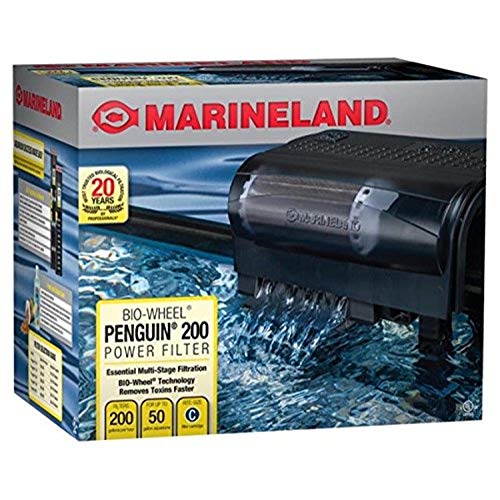
2. Marineland Penguin 200 Bio-Wheel Aquarium Filter
Best for: Medium freshwater tanks
The Marineland Bio-Wheel Penguin 200 is an aquarium power filter rated at 200 gallons per hour. It combines mechanical filtration for debris, chemical filtration for dissolved impurities, and biological filtration for beneficial bacteria. Its rotating Bio-Wheel adds wet/dry biological filtration as water passes through the system. At around $41, it sits in the affordable range for a multi-stage filter.
The main draw is the separate biological wheel, which gives this model more than a basic cartridge-only design. It uses Marineland Rite-Size cartridges, so replacement media is easy to identify, but your choices stay within that cartridge system. Marineland offers this filter line in five flow rates: 75, 100, 150, 200, and 350 GPH. The 200 GPH model suits shoppers who need more flow than smaller versions without moving to the largest unit. Match the flow to your tank and livestock before buying.
Pros
- Rotating Bio-Wheel supports wet/dry biological filtration.
- Three-stage filtration handles debris, dissolved impurities, and biological waste.
- Five available sizes make it easier to match flow needs.
Cons
- It requires compatible Marineland Rite-Size cartridges for routine media replacement.
- The 200 GPH rating may create too much flow for delicate fish or low-flow setups.
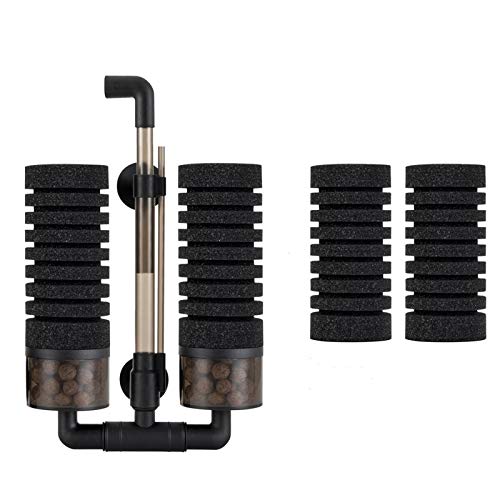
1. Hygger Aquarium Double Sponge Filter (M)
Best for: Shrimp tanks and gentle community aquariums
The Hygger Aquarium Double Sponge Filter combines mechanical filtration, biological filtration, and water movement in one compact unit. The medium model measures about 6.3 inches wide and 9 to 13 inches tall, with a suggested range of 15 to 55 gallons. It works in freshwater or saltwater tanks, but larger aquariums may need two filters. At around $20, it offers a useful setup for fish keepers on a budget.
Two fine 60 PPI sponges provide plenty of surface area for beneficial bacteria. The package includes two spare sponges, two media containers, and one bag of ceramic balls. You can remove the sponges for cleaning or replacement, then rinse them in old aquarium water instead of tap water. The outlet tube rotates and extends, while two suction cups hold the unit underwater. It needs a separate air pump and standard 4 mm airline tubing, neither of which comes included.
Pros
- Two 60 PPI sponges support mechanical and biological filtration.
- Ceramic media balls add extra space for beneficial bacteria.
- Adjustable outlet and suction cups allow flexible placement.
Cons
- An air pump and 4 mm airline hose must be purchased separately.
- Fine sponges can clog faster than coarse foam, especially in tanks with heavy debris.
Buying Guide
Gentle, adjustable water flow is the most important factor. Axolotls have delicate gills and prefer calm water, so a powerful filter can cause stress, damage, or poor feeding.
- Flow control: Choose a sponge, internal, or canister filter with adjustable output. A spray bar or pre-filter sponge can spread flow across a 30- to 36-inch tank.
- Filter capacity: Select a model rated for at least 1.5 times your aquarium’s volume. For a 20-gallon tank, choose a filter rated for 30 gallons or more.
- Filtration type: Use mechanical and biological filtration together. Coarse sponge removes waste, while ceramic media supports beneficial bacteria. Avoid relying on chemical cartridges alone.
- Maintenance needs: Pick media that rinses in removed tank water every 2 to 4 weeks. Replacement sponges should cost about $5 to $20 and last several months.
- Safety and noise: Cover intake openings with a pre-filter sponge to protect gills and prevent loose substrate from entering. Look for quiet operation below roughly 40 decibels, especially for bedrooms.
If you must compromise, prioritize adjustable, low-flow performance over extra features or compact size.
Frequently Asked Questions
How do I choose the right filter for an axolotl tank?
Choose a large, air-driven sponge filter with gentle flow, because axolotls need clean water without strong currents. Select a model rated for at least twice your aquarium’s volume, such as a 40-gallon filter for a 20-gallon tank. A pre-filter sponge can also protect the intake and reduce suction around the animal.
What type of filter is safest for an axolotl aquarium?
A sponge filter is usually the safest choice for an axolotl aquarium because it provides biological filtration with low water movement. Choose one with a coarse sponge and adjustable air control. A dual-sponge unit gives two separate surfaces for beneficial bacteria and keeps maintenance simple when one sponge needs rinsing.
Can I use a hang-on-back filter for an axolotl?
Yes, you can use a hang-on-back filter if you reduce its output and stop the return stream from pushing the animal around. Add a sponge pre-filter to the intake, then baffle the waterfall with aquarium-safe foam or a spray bar. Aim for gentle circulation across the tank without visible stress.
Are undergravel filters a good option for axolotl tanks?
Usually, no, undergravel filters are less practical for axolotls because waste can collect beneath the plates and complicate routine cleaning. A sponge filter keeps filtration accessible, and you can siphon debris during weekly maintenance while changing about 20 to 30 percent of the water. Axolotl tanks often produce noticeable solid waste.
Conclusion
Hygger Aquarium Double Sponge Filter (M) is the top pick for axolotl keepers who want gentle filtration and simple upkeep. If your priority is stronger mechanical filtration or more water capacity, choose a properly sized canister filter instead, then adjust its flow to keep the aquarium calm. Before buying, double-check the recommended tank size, air-pump and airline compatibility, quantity needed, and current price, since bundle contents can change. A sponge filter also needs an air pump, tubing, and routine cleaning, so include those parts in the budget if they are not included. Confirm that the filter provides enough biological media for your axolotl’s stocking level and tank volume.