
For most buyers, the Hygger Nano Aquarium Submersible Heater is the best 20 gallon aquarium heater, mainly because its compact design fits neatly around plants, rocks, and other tank décor. Its small footprint makes it a practical choice for community tanks where a bulky heater can take up valuable swimming space. It also suits aquarists who want a simple heater for smaller freshwater setups.
This guide is for anyone choosing a reliable aquarium warmer for a 20-gallon tank, from new fishkeepers to owners replacing an old unit. The key factors are correct wattage, accurate temperature control, heater size, and safety features such as automatic shutoff. A poorly matched heater can struggle to maintain stable water temperature or overheat a small tank. The five picks below are ranked with clear reasons and honest drawbacks for each.
Quick Comparison
| # | Product | Best For | Price | |
|---|---|---|---|---|
| 1 | hygger Nano Aquarium Submersible Heater | Nano tank owners | ~$24 | View → |
| 2 | NICREW 100W Aquarium Heater with Temperature Controller | Aquarists wanting temperature control | ~$24 | View → |
| 3 | hygger 200W Aquarium Heater | Larger aquarium setups | ~$38 | View → |
| 4 | hygger Aquarium Betta Heater, Submersible | Betta fish keepers | ~$17 | View → |
| 5 | AQUANEAT Aquarium Heater | Basic aquarium heating needs | ~$15 | View → |
5 Top Aquarium Heater Picks
These aquarium heaters are ranked by temperature control, safety features, and tank fit, counting down to the top pick.
5. AQUANEAT Aquarium Heater

Best for: 15–30 gallon freshwater tanks
The AQUANEAT 100W aquarium heater is designed for 15–30 gallon freshwater or marine tanks. It measures 8.25 inches long and uses a 6-foot power cord with a standard 110–120V, 60Hz connection. A top-mounted dial lets you set the temperature from 65°F to 89°F, giving you room to match the needs of many fish and turtles.
A red indicator light turns off when the selected temperature is reached. The heater then cycles to maintain steady warmth instead of running continuously. The package includes two suction cups for mounting and a separate digital thermometer for checking the water. That thermometer adds useful oversight, since the adjustment dial does not show the actual water temperature. Around $15, this warmer offers a practical setup for smaller aquariums, but it still requires careful handling. Fully submerge it before switching it on, unplug it, and wait at least 10 minutes before removal or tank maintenance.
Pros
- Covers 65°F to 89°F with a simple top adjustment dial.
- Includes a digital thermometer for checking actual water temperature.
- Six-foot cord and two suction cups support flexible placement.
Cons
- The 100W output is intended for 15–30 gallon tanks, limiting larger aquarium use.
- It must remain fully submerged while powered, and the heater can cause burns if touched when operating.
4. hygger Aquarium Betta Heater, Submersible

Best for: small betta and nano tanks
The hygger Small Aquarium Betta Heater is a compact submersible heater for freshwater or marine tanks. The 10-watt model fits aquariums up to 5 gallons, while 25W, 50W, and 100W versions cover tanks up to 10, 16, and 26 gallons. Its 59°F to 93°F temperature range suits many small fish and turtle setups. At around $17, it is a relatively affordable option for temperature control.
The heater uses 2mm-thick quartz glass and measures about 4.1 inches long. That thumb-sized design takes up less room than many standard aquarium heaters, which helps in small tanks where equipment quickly crowds the swimming area. An external controller shows the current water temperature on an LED display and lets you adjust settings without putting your hands in the tank. Safety controls stop heating if the water rises above 95°F or drops below the minimum level. The display then shows HH for high temperature or E1 for operation outside the water.
Pros
- Compact 4.1-inch body fits nano and betta aquariums.
- External LED controller displays temperature clearly.
- Dry-run and high-temperature protection reduce overheating risk.
Cons
- The controller and cord add extra equipment outside the tank.
- You must unplug it before cleaning or changing aquarium water.
3. hygger 200W Aquarium Heater

Best for: Medium freshwater and saltwater tanks
The hygger 200W aquarium heater is designed for 20- to 40-gallon freshwater or saltwater tanks. Its temperature range runs from 59°F to 93°F, with adjustments in 0.5°F steps through an external controller. Around $38, it costs more than basic glass heaters, but includes two suction cups and a 24-month warranty.
The quartz glass heating tube uses nickel-chromium wire and silicon carbide for heat transfer. A black ABS shell helps shield fish and tank occupants from the hot surface. Safety controls stop heating when the set temperature is reached, shut down if the unit leaves the water, and trigger an alarm above 97.7°F. An anti-boiling system can cut power within 10 seconds during a malfunction. Near the target temperature, the heater reduces output to 10% to 30% instead of running at full power. Proper placement still matters, since this is a submersible device that must remain underwater.
Pros
- Covers 20- to 40-gallon tanks with adjustable temperatures from 59°F to 93°F.
- Dry-run protection and automatic over-temperature shutdown add useful safeguards.
- Includes two suction cups, an external controller, and a 24-month warranty.
Cons
- The 200W output is oversized for tanks below 20 gallons and may be insufficient above 40 gallons.
- It requires careful placement below the waterline, and the suction cups may need periodic checking.
2. NICREW 100W Aquarium Heater with Temperature Controller

Best for: 10-20 gallon tropical tanks
The NICREW 100W aquarium heater is made for 10- to 20-gallon tanks that need stable warm water. Its external temperature controller lets you adjust the setting without putting your hands in the tank. A power-off memory function keeps the previous setting after an outage, so you do not need to reset it each time.
Dual temperature sensors help the controller read water temperature with less guesswork. The heater shuts off when water rises above 98°F (36°C), adding protection against excessive heat. Its nickel-chromium alloy heating element is built for quick warming, while magnesium oxide inside helps move heat into the water. Suction cups attach the unit to the aquarium wall. The external design keeps routine adjustments away from the water surface, which is useful during feeding or maintenance. The heater must stay fully submerged and sit near good water flow, or readings can vary. At around $24, it offers useful controls for a modest tank, but its 100W output is tied to this size range.
Pros
- External controller allows temperature changes with dry hands.
- Power-off memory preserves the previous temperature setting.
- Automatic cutoff at 98°F (36°C) helps limit overheating.
Cons
- The heater must be fully submerged and placed in moving water for reliable readings.
- Its 100W rating is intended for 10- to 20-gallon tanks, not larger aquariums.
1. hygger Nano Aquarium Submersible Heater
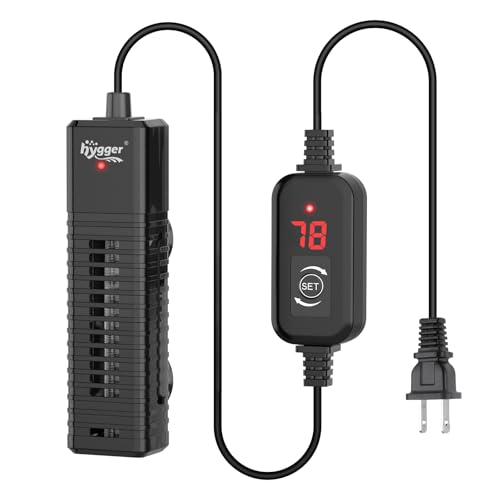
Best for: Compact 15-20 gallon freshwater tanks
The hygger Nano Aquarium Submersible Heater is a 100-watt heating rod for smaller aquariums. It measures 4.9 by 1.3 by 0.9 inches, so it can fit near a corner without taking much room from plants, rocks, or swimming space. A porous ABS cover surrounds the quartz glass tube and nickel-chromium heating wire, helping spread heat through the water. At around $24, it sits in the affordable range for a heater with an external control unit.
The controller adjusts from 59°F to 93°F and shows the heater’s operating status. Its built-in probe reads the water temperature with stated accuracy of plus or minus 2°F. That range suits freshwater animals such as bettas, shrimp, snails, and shallow-water turtles. The unit also remembers its temperature setting after a power outage. Overheat and low-water alarms add useful warnings, but you must correct the problem manually before clearing the alert. This heater is best suited to stable, properly filled tanks rather than large aquariums or setups with wide temperature swings.
Pros
- Compact 4.9-inch body takes up little space in a nano aquarium.
- Adjustable 59°F to 93°F range supports several freshwater species.
- Power-off memory saves the temperature setting after an outage.
Cons
- The stated temperature accuracy is only plus or minus 2°F, which may be too broad for sensitive species.
- Its 100-watt capacity is intended for 15-20 gallon tanks, limiting use in larger aquariums.
Buying Guide
The most important factor is correct wattage for your room temperature. A 50-watt model usually suits a 20-gallon tank, while a 100-watt unit may work better in rooms below 65°F.
- Wattage: Choose about 2.5 to 5 watts per gallon. For a 20-gallon aquarium, compare 50-watt and 100-watt options, then follow the manufacturer’s room-temperature chart.
- Temperature control: Select an adjustable thermostat covering at least 68°F to 88°F. Set most tropical aquariums near 75°F to 78°F, and use a separate thermometer to verify the water.
- Safety features: Look for automatic shutoff when the heater leaves the water or reaches the target temperature. A shatter-resistant guard adds protection for tanks with active fish.
- Size and placement: Measure the heater before buying. A unit around 8 to 12 inches long should fit many 20-gallon tanks, but confirm clearance near the substrate, filter, and lid.
- Construction and cost: Glass heaters often cost $20 to $40, while plastic-bodied versions can cost more. Check for suction cups, a power light, and a cord at least 6 feet long.
If you cannot prioritize everything, choose accurate temperature control and the correct wattage first.
Frequently Asked Questions
How do I choose a heater for a 20-gallon fish tank?
Choose a thermostatic, fully submersible aquarium heater rated for 20 gallons, with enough wattage for your room temperature. For most homes, 50 watts suits a 20-gallon tank, while 75 to 100 watts may fit colder rooms. Select a model with an adjustable thermostat, clear temperature markings, and a protective guard.
What temperature should a 20-gallon fish tank heater maintain?
A heater for a 20-gallon aquarium should maintain the species’ required temperature, often 75 to 80°F for tropical community fish. Check the care range for every fish first, then place a thermometer opposite the heater to verify the water stays stable.
Can I use a 100-watt heater in a 20-gallon aquarium?
Yes, a 100-watt adjustable heater can work in a 20-gallon aquarium if its thermostat and manufacturer rating suit that volume. It may heat water faster than a 50-watt unit, so use a separate thermometer and unplug it during water changes.
Do 20-gallon aquariums need a heater?
Most 20-gallon tanks need a heater for tropical fish, but cold-water species may not need one if the room stays within their safe range. A reliable heater becomes useful when temperatures drop below the target, such as 72°F for fish requiring warmer water.
Conclusion
For most 20-gallon tank owners, the hygger Nano Aquarium Submersible Heater is the top pick for shoppers who want a compact heater with straightforward temperature control. If your priority is backup protection or more precise monitoring, choose a model with an external controller, a visible temperature display, or two smaller heaters instead. Before buying, double-check the heater’s physical size, wattage, tank compatibility, required quantity, and current price, since a unit rated for 20 gallons may not suit every setup. Also confirm that the heater can stay fully submerged and that your aquarium has safe clearance around it. A reliable thermostat matters, but regular checks still help protect fish from sudden temperature changes.