
For most buyers, the AQUANEAT 5-Inch Cylindrical Air Stone, 2-Pack is the top pick and the best aquarium air stone because its 5-inch length spreads bubbles across a broad area. The two-pack also provides a useful spare. Its porous cylinder should deliver steady aeration with a compatible air pump. The stones do not include a pump, tubing, or suction cups, so budget for those parts if needed.
This guide is for fish keepers who want more oxygen movement or gentler surface agitation in freshwater and marine tanks. Focus on diffuser size, bubble distribution, material, and pump compatibility. A larger stone needs enough airflow, while an undersized one may not circulate water well. The five picks below are ranked with reasons and honest drawbacks for each, so you can match the diffuser to your tank and equipment.
Quick Comparison
| # | Product | Best For | Price | |
|---|---|---|---|---|
| 1 | AQUANEAT 5-Inch Cylindrical Air Stone, 2-Pack | Spare Air Stone Pair | ~$8 | View → |
| 2 | Pawfly Aquarium Air Stone Aerator | Small Tank Bubble Aeration | ~$4 | View → |
| 3 | Pawfly 4-Inch Air Stone Disc Diffuser | Compact Disc Diffuser Setup | ~$14 | View → |
| 4 | VIVOSUN 5-Inch Air Stone Disc | Larger Aquarium Oxygenation | ~$15 | View → |
| 5 | Uniclife Aquarium Air Pump | First-Time Aquarium Keepers | ~$15 | View → |
5 Top Aquarium Air Stone Picks
Here are five aquarium air stones, ranked from useful budget options down to the strongest overall pick.
5. Uniclife Aquarium Air Pump
Best for: Freshwater and marine tank owners
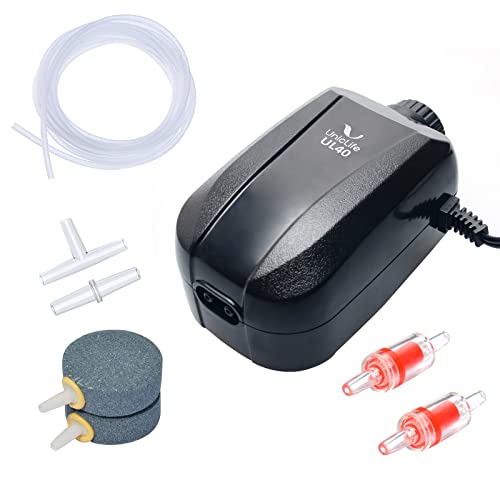
The Uniclife aquarium air pump is a compact aeration kit for tanks from 10 to 100 gallons. It produces up to 64 GPH with 4 watts of power and 0.016 MPa of pressure. A single rotary control adjusts airflow across its two outlets, so you can run two air stones or reduce bubbling for a quieter setup. At around $15, it includes the main parts needed for basic tank aeration.
Two disc-shaped air stones create steady, medium-sized bubbles that help circulate water at the surface. The package also includes 6.5 feet of airline tubing, two check valves, and two connectors. Noise varies by setting. Uniclife lists about 25 dB on low and up to 45 dB at full output, roughly comparable to a refrigerator’s hum. The pump fits a wide range of tank sizes, but actual airflow can drop if the intake cotton becomes blocked. That filter material may need replacement over time.
Pros
- Dual outlets let you aerate two areas or tanks.
- Adjustable airflow supports quieter, lower-bubble operation.
- Includes two air stones, tubing, valves, and connectors.
Cons
- The top setting can reach 45 dB, which may be noticeable in quiet rooms.
- Blocked intake cotton can reduce airflow and requires maintenance.
4. VIVOSUN 5-Inch Air Stone Disc

Best for: Aquariums needing broad bubble coverage
This 5-inch VIVOSUN air stone disc adds aeration to aquariums, ponds, fish tanks, and hydroponic systems. It measures 5 inches across and 0.8 inches high, so it covers more area than a small cylindrical stone. The included shell and suction cup help keep it positioned on the tank floor. It connects to standard 4 mm, or 0.16-inch, airline tubing.
The stone uses mineral material sintered at high temperature. Its porous surface creates a dense stream of fine bubbles when paired with a suitable air pump. VIVOSUN recommends a pump rated from 4 to 16 watts, giving buyers a fairly broad range of compatible equipment. Before the first use, soak the disc fully for two hours. Regular brushing also matters, since mineral deposits and debris can clog the pores after weeks or months. At around $15, it offers a low-cost way to add oxygen movement, but the stone needs routine care and a separate pump setup.
Pros
- The 5-inch disc spreads fine bubbles across a wider area than compact air stones.
- The included shell and suction cup help limit unwanted movement.
- Compatible with common 4 mm airline tubing and 4 to 16-watt pumps.
Cons
- A two-hour pre-soak delays installation and first use.
- The porous surface can clog after weeks or months, requiring regular brushing and cleaning.
3. Pawfly 4-Inch Air Stone Disc Diffuser

Best for: DWC growers and aquarium keepers
The Pawfly ASD100 is a 4-inch air stone disc for aquariums, ponds, buckets, and deep-water culture reservoirs. It connects to an air pump and releases medium-sized bubbles across the disc surface. The listed jetting volume is 12 L/min, with a recommended pump rated above 4 watts. It fits tubing with a 3/16-inch or 3/8-inch inner diameter, so buyers should check their hose size first.
The disc measures 4.1 inches across and 0.7 inches tall. At 7 ounces, it can sink without extra weights. Three suction cups help hold it against the tank floor, although suction performance can vary by surface. Its sintered mineral construction is designed for regular aquatic use. Before first use, soak it fully for one hour. The pores can clog after several weeks or months, so cleaning with a brush becomes part of routine care. The two-pack costs around $14, which suits setups needing a spare or two air outlets.
Pros
- Produces 12 L/min of bubbles for added water movement and aeration.
- Three suction cups help keep the diffuser positioned on the bottom.
- Two discs provide a spare or support separate tanks and reservoirs.
Cons
- It requires a pump above 4 watts, which may exceed the output of small air pumps.
- Regular brushing is necessary because mineral pores can clog over time.
2. Pawfly Aquarium Air Stone Aerator
Best for: Nano tanks and small buckets
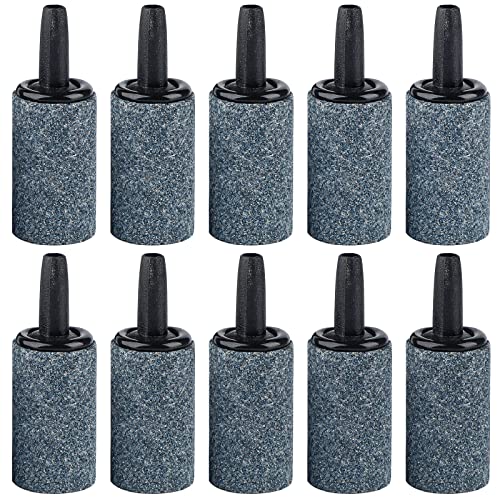
The Pawfly ASC-025 is a compact air stone for small aquariums, fish tanks, and buckets. The 10-pack gives you spares for replacements or multiple setups. Each mineral-based cylinder measures 0.6 inches wide by 1 inch tall and weighs 0.3 ounces. Its high-temperature-sintered material is designed for aquarium use, but the stones still need regular cleaning as buildup collects.
Each diffuser produces medium-sized, dense bubbles at a listed jetting volume of 0.8 L/min. That output can improve water movement and oxygen exchange in a small tank without requiring a large pump. The stones fit standard 3/16-inch airline tubing and work with 2 to 4-watt nano air pumps. Soak each piece fully for one hour before connecting it. A brush can clear clogs after several weeks or months. At around $4, the pack offers a low-cost way to keep replacements nearby.
Pros
- Ten stones provide backups for several small setups.
- Compact 1-inch size suits nano aquariums and buckets.
- Works with low-power 2 to 4-watt air pumps.
Cons
- The 0.8 L/min output is intended for small containers, not large tanks.
- Each stone needs a one-hour soak before first use and periodic brushing when clogged.
1. AQUANEAT 5-Inch Cylindrical Air Stone, 2-Pack
Best for: Larger aquariums and hydroponic reservoirs
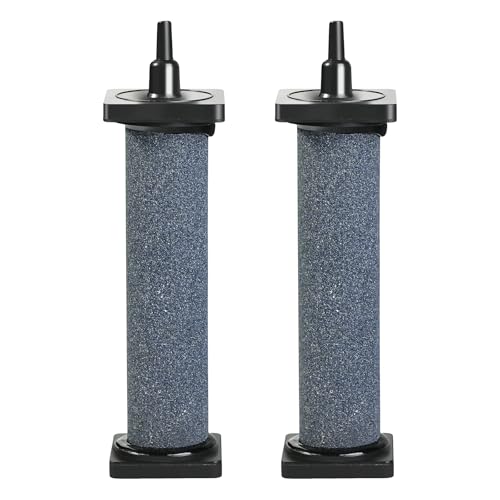
The AQUANEAT Aquarium Air Stone set includes two cylindrical diffusers, each measuring 1.5 inches in diameter and 5 inches tall. They fit standard 3/16-inch airline tubing and work with aquariums, ponds, and hydroponic systems. The stones create dense, medium-sized bubbles that help move oxygen through the water. That added aeration can support fish, plant roots, and nutrient solutions. At around $8, this two-pack is an affordable option for larger tanks or replacement use.
Each stone includes a base, so it can rest securely on the bottom instead of tipping over. The tall cylinder also provides a larger aeration area than a small disc-style stone. AQUANEAT recommends using an air pump rated at least 5 watts, so buyers should check their existing equipment before ordering. Preparation takes some time. Soak each diffuser fully in water for one hour before connecting it. Regular cleaning also matters, since mineral buildup and debris can clog the pores after several weeks or months.
Pros
- Two 5-inch stones provide broad aeration coverage.
- Bases help keep the diffusers stable on the tank floor.
- Standard 3/16-inch tubing supports common aquarium setups.
Cons
- Requires a pump rated at least 5 watts, which may cost extra.
- Needs a one-hour soak before use and regular brushing to prevent clogging.
Buying Guide
The most important factor is matching the diffuser’s size and resistance to your air pump. A stone that is too large for the pump may produce weak bubbles, while a tiny one can create poor circulation in a larger tank.
- Tank and stone size: Choose about 1 inch of stone length per 10 gallons, such as a 4-inch model for a 40-gallon aquarium, when the manufacturer gives no other guidance.
- Bubble size: Pick fine bubbles for oxygen exchange and gentle circulation. Coarse bubbles suit stronger surface movement or tanks with larger fish.
- Pump output: Check the required airflow, usually listed in liters per minute. A pump producing 2-4 L/min commonly fits a 10- to 30-gallon setup, but verify the stone’s rating.
- Material and durability: Ceramic and mineral stones often last longer than soft foam. Look for a weighted base and a 3/16-inch airline connection that matches your tubing.
- Maintenance and value: Rinse the diffuser every 2-4 weeks and replace it when output stays weak after cleaning. Two- to four-packs often cost $6-$15 and provide a spare.
If you must compromise, prioritize pump compatibility because airflow controls the diffuser’s actual performance.
Frequently Asked Questions
How do I choose an aquarium air stone?
Choose an aquarium air stone by matching its size, bubble output, and air-pump capacity to your tank. Porous ceramic models create fine bubbles, while larger wood or plastic diffusers may move more water. For example, a 4-inch stone suits many small to medium tanks, but check the package rating first.
What is the best way to clean an air diffuser for a fish tank?
The best way to clean an air diffuser is to scrub it, soak it in diluted bleach, and rinse it thoroughly with dechlorinated water. Replace it if airflow stays weak after cleaning. A common routine uses one part unscented bleach to nine parts water, followed by a 24-hour soak in fresh water.
Can an aquarium bubbler work without an air pump?
No, an aquarium bubbler cannot produce bubbles without an air pump or another pressurized air source. The pump pushes air through airline tubing and the porous stone. Battery-powered pumps still count as pumps. A USB or plug-in model usually runs continuously, while battery units may last only several hours.
Are fine bubbles better for aquarium oxygenation?
Fine bubbles are usually better for gas exchange because they provide more water contact than large bubbles. They also create gentler circulation for small fish and shrimp. However, a stone that clogs quickly loses output. Clean the diffuser when bubbles become uneven, often every 2 to 4 weeks.
Conclusion
AQUANEAT 5-Inch Cylindrical Air Stone, 2-Pack is the top pick for aquarium owners who want broad, steady bubble coverage and a spare stone ready for replacement. If your priority is a smaller tank or tighter placement, choose a compact air stone instead, since a five-inch model may take up too much room and produce more bubbles than needed. Before buying, double-check the stone’s length, airline compatibility, pack quantity, and current price, since listings can change. Match the stone to your tank’s layout and pump output, then place it where rising bubbles can circulate water without disturbing fish or plants. A simple fit check can prevent weak airflow, crowded décor, and an unnecessary return.