
The Tetra Whisper EX 70 Aquarium Filter is the top pick for most buyers and the best filter for a 55 gallon fish tank because its 70-gallon rating provides useful capacity beyond the tank’s actual volume. That extra margin can help manage waste and keep water moving steadily in a fully stocked aquarium.
This guide is for fishkeepers who want clearer water without buying an oversized system. The most important factors are rated capacity and filter size, since a unit must handle the tank’s bioload while fitting behind or beside the aquarium. Media cost also matters because cartridges and other inserts need regular replacement. The five picks below are ranked with clear reasons and honest drawbacks for each, covering options for community tanks, planted setups, and aquariums with heavier fish loads.
Quick Comparison
| # | Product | Best For | Price | |
|---|---|---|---|---|
| 1 | Tetra Whisper EX 70 Aquarium Filter | Large freshwater tanks | ~$56 | View → |
| 2 | Submersible Aquarium Filter | Small desktop aquariums | ~$38 | View → |
| 3 | Marineland Penguin 200 Aquarium Filter | Budget-conscious fishkeepers | ~$41 | View → |
| 4 | Tetra Whisper IQ Power Filter | Noise-sensitive bedroom aquariums | ~$51 | View → |
| 5 | Aqua-Tech Ultra Quiet Power Filter | Easy cartridge replacement seekers | ~$66 | View → |
5 Top Filters for 55-Gallon Tanks
These five filters are ranked by fit, flow, maintenance, and value, counting down to the top pick.
5. Aqua-Tech Ultra Quiet Power Filter
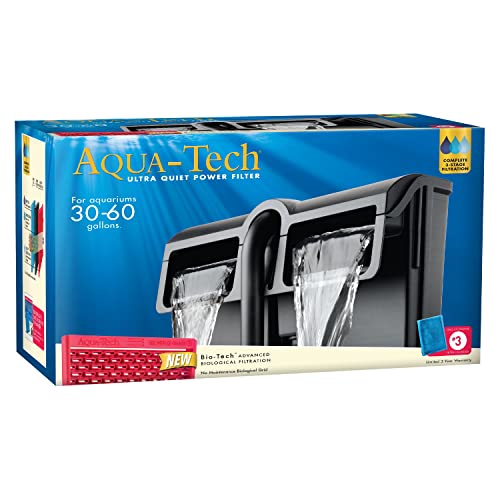
Best for: Owners of 30-60 gallon aquariums
The Aqua-Tech Ultra Quiet Power Filter is designed for aquariums from 30 to 60 gallons. It uses a three-step filtration process to catch dirt and remove impurities as water passes through the unit. The package includes one EZ-Change #3 filter cartridge, so buyers receive the main cartridge needed for initial setup. Aqua-Tech also offers related sizes for 5-15, 10-20, and 20-40 gallon tanks, but this version targets larger home aquariums.
Its strongest feature is the combination of simple sizing and staged filtration. Water receives more contact with the cartridge’s carbon, which helps address dissolved impurities along with visible debris. The cartridge format should make routine changes simpler than loose-media setups. At around $66, it costs more than many small-tank filters, but its larger capacity helps explain the price. A limited three-year warranty adds useful coverage, although buyers should review the terms first. The quiet design may suit living rooms or bedrooms, but the listed specifications do not provide a measured noise rating or flow rate.
Pros
- Three-step filtration captures dirt and uses carbon contact to remove impurities.
- Designed for 30-60 gallon aquariums, with three smaller sizes available.
- Includes one EZ-Change #3 cartridge and a limited three-year warranty.
Cons
- Only one cartridge comes in the box, so replacements will add ongoing cost.
- No published noise rating or flow rate makes performance harder to judge before purchase.
4. Tetra Whisper IQ Power Filter
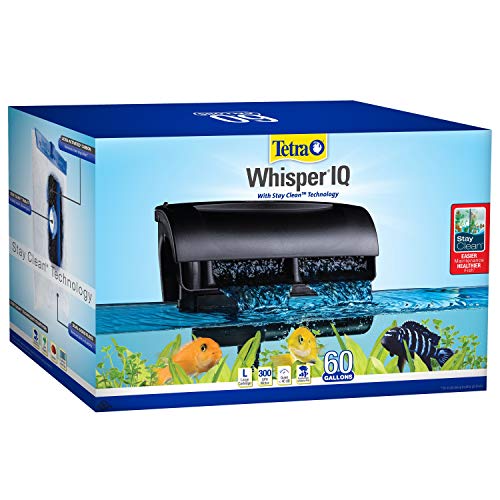
Best for: owners of medium freshwater aquariums
The Tetra Whisper IQ 300 GPH Power Filter is an external hang-on-back filter for aquariums up to 60 gallons. Its submerged motor starts without manual priming, which simplifies setup after cleaning or a power outage. Water moves at up to 300 gallons per hour, giving medium tanks a steady flow rate. The unit includes a sound shield designed to keep operating noise below 40 dB, a useful detail for bedrooms, offices, and living rooms.
Its Stay Clean design supports stable pH levels and may help reduce routine maintenance. The filter uses large Tetra Whisper Bio-Bag cartridges, which should be replaced about once a month. Those refills cost extra and are sold separately. Around $51, this filter sits in the midrange for a 60-gallon hang-on-back model. The main appeal is simple operation paired with quieter filtration. Still, cartridge-based filtration creates an ongoing supply cost, and the 300 GPH flow may feel too strong for delicate fish unless the output is adjusted.
Pros
- Submerged motor starts automatically without manual priming.
- Sound shield keeps rated noise below 40 dB.
- Supports aquariums up to 60 gallons with 300 GPH flow.
Cons
- Large Bio-Bag cartridges need monthly replacement, and refills cost extra.
- The fixed 300 GPH rating may create too much current for some gentle-flow fish.
3. Marineland Penguin 200 Aquarium Filter
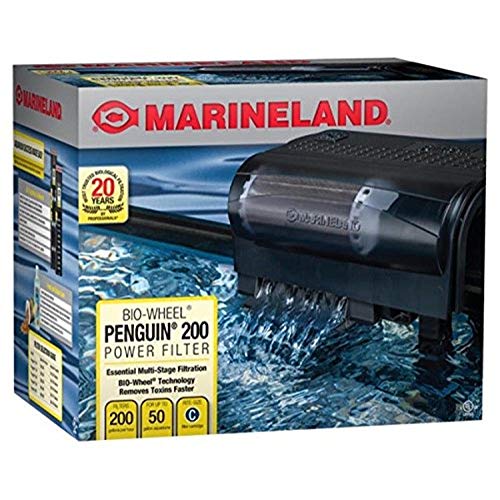
Best for: medium freshwater aquariums needing simple filtration
The Marineland Bio-Wheel Penguin 200 GPH Power Aquarium Filter is a multi-stage filter designed to clean aquarium water through mechanical, chemical, and biological processes. Its 200 GPH rating identifies the water-processing capacity, while the rotating Bio-Wheel supports wet/dry biological filtration. This format gives beneficial bacteria a dedicated surface for growing, alongside the replaceable filter cartridge.
What sets this model apart is the rotating wheel, which adds biological filtration without requiring a separate tank accessory. The filter works with Marineland Rite-Size cartridges, so replacement parts are easy to match when shopping. Marineland offers this design in five flow sizes: 75, 100, 150, 200, and 350 GPH. That range makes it easier to choose a model for different aquarium setups, though the 200 GPH version is the focus here. At around $41, it sits in the midrange for a basic power filter, with ongoing cartridge costs to consider.
Pros
- The 200 GPH flow rate supports regular water circulation in many medium aquarium setups.
- Mechanical, chemical, and biological filtration work together in one filter.
- The rotating Bio-Wheel provides wet/dry biological filtration for beneficial bacteria.
Cons
- It requires compatible Marineland Rite-Size cartridges, creating a recurring replacement expense.
- The listed features do not include adjustable-flow details, which may matter for fish that prefer gentler current.
2. Submersible Aquarium Filter

Best for: Large aquariums needing low-maintenance filtration
This submersible internal filter is designed for aquariums from 55 to 100 gallons. It combines sponge and biological filtration in one unit, while drawing water from the bottom and moving it through the full filter body. That design may help reduce water bypassing the media. The filter also adds bubbles and surface movement, which can increase oxygen exchange. At around $38, it offers a practical setup for larger community tanks.
The main advantage is its adjustable size. Fully assembled, it measures 15.3 inches tall and 3.14 inches wide. Remove one detachable section, and it becomes 11.4 inches tall for tanks with less vertical space. Its reusable sponges are designed to last for the life of the filter, so there are no routine replacement pads to buy. It can also work in some turtle setups. A one-year warranty is available after registration. The maker does not recommend it for small shrimp or infant fish.
Pros
- Covers a wide 55-to-100-gallon aquarium range.
- Detachable sections provide two height options.
- Reusable sponges can reduce ongoing filter-media costs.
Cons
- The 15.3-inch full height may be too large for shallow tanks.
- It is not suitable for small shrimp or very young fish.
1. Tetra Whisper EX 70 Aquarium Filter
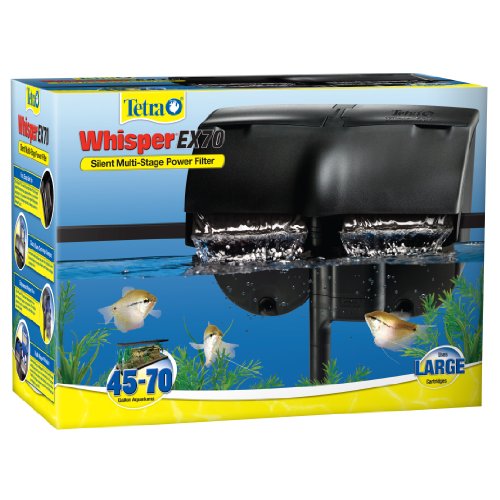
Best for: Large freshwater community aquariums
The Tetra Whisper EX 70 is a hang-on-back power filter for aquariums from 45 to 70 gallons. It uses multi-stage filtration to help remove suspended debris and keep water clearer. The filter moves water continuously, which can reduce stagnant areas where waste collects. At around $56, it sits in the midrange for a filter designed for larger home tanks.
Setup is simple because the unit does not require manual priming out of the box. Its motor is designed for quiet operation, a useful trait for bedrooms, offices, and living rooms. Cartridge changes should also create less dripping than some traditional filter designs, so routine maintenance stays more controlled. The main concern is fit. This model targets 45- to 70-gallon aquariums, so it may provide too much flow or occupy too much space on smaller tanks. You will also need replacement cartridges over time, which adds to the long-term cost.
Pros
- Fits larger 45- to 70-gallon aquariums.
- Multi-stage filtration supports clearer, cleaner water.
- No-priming setup and reduced-drip cartridge changes simplify maintenance.
Cons
- The large size may not suit smaller tanks or compact stands.
- Replacement cartridges create an ongoing operating expense.
Buying Guide
Adequate flow is the most important factor when choosing filtration for a 55-gallon aquarium. Aim for 220 to 330 gallons per hour, or four to six tank turnovers, because filter ratings often drop after media and tubing are installed.
- Flow rate: Choose a model rated for at least 55 gallons and delivering 220 to 330 GPH. Use an adjustable output if your fish prefer gentle currents.
- Filtration stages: Look for mechanical, biological, and chemical media. A unit with two or more media baskets gives you room for coarse sponges, ceramic rings, and activated carbon.
- Tank fit: Measure the aquarium rim and available cabinet space before buying. Hang-on-back filters often need 5 to 10 inches of clearance behind the tank.
- Maintenance needs: Pick washable foam or sponge media that you can rinse every two to four weeks. Replace disposable carbon cartridges about monthly, if you use carbon.
- Noise and power: Check for an adjustable intake and a quiet pump design. A filter using roughly 5 to 15 watts usually costs less to run than larger systems.
If you cannot have everything, prioritize the correct flow rate and enough biological media for stable water quality.
Frequently Asked Questions
How do I choose a filter for a 55-gallon fish tank?
For a 55-gallon aquarium, choose a filter rated for at least 55 gallons with adjustable flow and mechanical, biological, and chemical media options. A turnover target of about 4 to 6 times the tank volume per hour means roughly 220 to 330 gallons per hour, though messy fish may need more filtration.
What type of filter is best for a 55-gallon aquarium?
An adjustable hang-on-back filter is the best choice for many 55-gallon tanks because it is easy to maintain, affordable, and simple to monitor. Choose one rated for at least 75 gallons, then reduce its flow for slow-moving fish or increase surface movement for oxygen-hungry species.
Can one filter handle a 55-gallon fish tank?
Yes, one properly sized aquarium filter can handle a lightly or moderately stocked 55-gallon tank. Select a unit rated above the tank’s capacity, such as a 75- or 90-gallon model, and clean media in removed tank water so beneficial bacteria are not stripped by tap-water chlorine.
Are canister filters good for 55-gallon tanks?
Canister filters are often better for heavily stocked 55-gallon aquariums or setups needing quiet operation and extra media space. Their sealed bodies hold more material than many hang-on-back designs, but cleaning takes longer. A 4-to-8-week service schedule is common, but heavy waste may require more frequent cleaning.
Conclusion
The Tetra Whisper EX 70 Aquarium Filter is our top pick for 55-gallon tank owners who want a familiar hang-on-back design with room for routine media changes. If your priority is quieter operation, stronger biological filtration, or a different setup style, choose an alternative that matches that specific need instead of paying for features your aquarium will not use. Before buying, double-check the stated tank size, filter compatibility with your fish and equipment, the quantity of replacement cartridges or media included, and the current price. Also measure the space behind the aquarium, since a filter can fit the tank’s volume yet fail to clear the lid or wall. Plan for regular maintenance and replacement media costs.