
The PONDFORSE Canister Aquarium Filter is the best canister filter for turtle tank for most buyers. Its main advantage is multi-stage filtration, which helps handle the heavy waste turtles produce. Owners can also choose media for odor control, biological filtration, or fine particles.
This guide is for turtle keepers choosing a filter for a new setup or replacing an underpowered unit. Focus on flow rate and media capacity. The unit must move enough water for the tank while holding enough media between cleanings. Noise, hose layout, and canister access affect daily use. The six picks below are ranked with clear reasons and honest drawbacks for each, so you can match one to your tank size, maintenance habits, and budget.
Quick Comparison
| # | Product | Best For | Price | |
|---|---|---|---|---|
| 1 | PONDFORSE Canister Aquarium Filter | Best for Small Freshwater Tanks | ~$70 | View → |
| 2 | PONDFORSE Canister Aquarium Filter | Best for Budget-Conscious Aquarium Owners | ~$80 | View → |
| 3 | Fluval 107 Canister Aquarium Filter | Best for Quiet Filtration | ~$140 | View → |
| 4 | AMOSIJOY Canister Filter | Best for Compact Turtle Habitats | ~$70 | View → |
| 5 | AMOSIJOY Canister Filter | Best for Beginner Fishkeepers | ~$60 | View → |
| 6 | Fluval FX2 Canister Aquarium Filter | Best for Large Aquariums | ~$297 | View → |
6 Top Canister Filters for Turtle Tanks
These six canister filters are ranked by filtration, flow control, maintenance needs, and turtle-tank suitability, counting down to the top pick.
6. Fluval FX2 Canister Aquarium Filter

Best for: Large freshwater aquarium owners
The Fluval FX2 is a canister filter for aquariums that need strong circulation and several layers of filtration. Its pump moves up to 475 US gallons, or 1,800 liters, of water per hour. A built-in microchip monitors pump operation, while the self-starting system evacuates trapped air every 12 hours. At around $297, it costs more than many mid-size filters.
Inside, four removable baskets hold up to 1 US gallon, or 3.9 liters, of mechanical, chemical, and biological media. That gives you room to adjust the setup for your aquarium instead of relying on one fixed combination. The 16.5-inch, or 42-centimeter, canister is 15% smaller than the FX4 and fits under many aquarium stands. A base drain simplifies water changes, and lid-mounted clips keep the hoses stored when disconnected. Rubber feet help limit vibration, while the one-way impeller design reduces mechanical joints that can create noise.
Pros
- Moves up to 475 US gallons per hour for strong filtration.
- Four baskets prevent water bypass and hold up to 3.9 liters of media.
- Base drain supports easier water changes without lifting the canister.
Cons
- Around $297, it requires a larger budget than many aquarium filters.
- Its 475 GPH flow may be too strong for small or low-flow aquariums.
5. AMOSIJOY Canister Filter
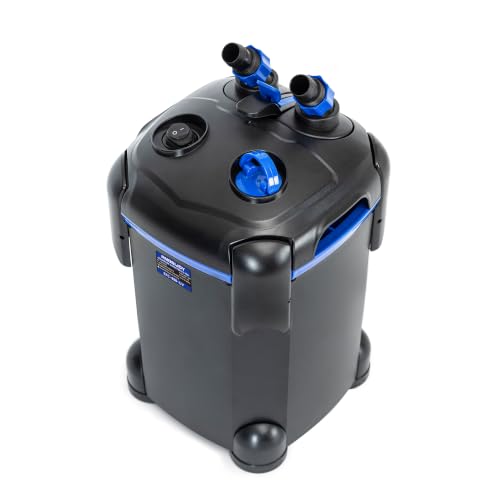
Best for: Large freshwater and turtle tanks
The AMOSIJOY Ultra-Quiet Canister Filter is an external aquarium filter for freshwater tanks, turtle setups, and aquariums with heavier water demands. It uses an adjustable flow valve, so you can reduce the output from maximum down to zero. That range helps when fish need gentler circulation or turtles need a different flow level. The manufacturer lists noise at 30 dB or less, along with low power use and high flow.
The standout feature is the included water-filling nozzle. Add water through the inlet system, open the flow valve, and plug in the filter. This avoids a more strenuous manual priming process. Two bulbs are included, giving you a replacement if the assembled bulb fails. The package also contains filter sponges and bio balls for mechanical and biological filtration. At around $60, it offers useful extras for the price, though buyers should confirm that its flow suits their tank.
Pros
- Adjustable output can run from full flow to zero, supporting fish and turtle tanks.
- Two bulbs reduce downtime when one needs replacement.
- Included sponges and bio balls reduce the need for separate media purchases.
Cons
- The available details do not state a tank-size rating, flow rate, or wattage, so compatibility needs checking.
- As an external canister, it needs hose space and regular media cleaning, which may be more work than an internal filter.
4. AMOSIJOY Canister Filter

Best for: Green-water tanks needing quiet filtration
The AMOSIJOY Ultra-Quiet Canister Filter is an external aquarium filter for freshwater tanks and turtle setups. It uses low wattage, adjustable water flow, filter sponges, and bio balls to remove debris and support biological filtration. The flow valve can reduce output from maximum to zero, which helps when fish or turtles need different water movement. It costs around $70, though prices can change.
Two bulbs come with the unit, including one spare for replacement. These bulbs target green water, so they may help improve cloudy, algae-filled tanks over time. A water-filling nozzle simplifies startup. Add water through the inlet, open the flow valve, and plug in the filter. The advertised sound level is 30 dB or less, which suits living rooms and bedrooms better than louder pumps. A 180-day warranty provides limited coverage if the filter develops a problem.
Pros
- Two bulbs provide a spare when the installed bulb fails.
- Adjustable flow works for fish tanks and turtle tanks.
- Sponges and bio balls are included with the filter.
Cons
- The listing does not provide a tank-size range or specific flow rate.
- Bulbs, sponges, and other media need periodic cleaning or replacement.
3. Fluval 107 Canister Aquarium Filter

Best for: Quiet filtration in smaller aquariums
The Fluval 107 is a canister filter designed for aquariums up to 30 gallons. Its eTEC pump provides steady water movement and pressure, while using about the same energy as an LED light bulb. That makes it a practical choice for fish keepers who want external filtration without a large power draw. Around $140, it costs more upfront than many basic hang-on-back filters.
Noise control is a major focus here. Fluval says this model runs up to 25% quieter than its previous version, which can help in bedrooms, offices, or living rooms. The motor is built for constant pumping, so the filter can support regular mechanical, chemical, and biological media use. Its EZ-Lift baskets also make maintenance less awkward. A center handle lets you remove the media stack with one finger, giving you faster access during cleanouts. Still, canister filters require hose setup and periodic servicing, so they are not the simplest option for new aquarium owners.
Pros
- Rated for aquariums up to 30 gallons.
- Uses energy similar to an LED light bulb.
- EZ-Lift baskets allow one-finger removal.
Cons
- Around $140 is a high starting price for a small-tank filter.
- Canister filters need hose installation and regular media cleaning.
2. PONDFORSE Canister Aquarium Filter

Best for: Freshwater tanks needing adjustable external filtration
The PONDFORSE Canister Filter is an external aquarium filter that uses layered media to catch particles and remove impurities from the water. Its included kit contains sponges, filter balls, and a spare bulb, so buyers have the main pieces needed to set up filtration without immediately purchasing extra media. At around $80, it targets aquarium owners who want more filtration than a basic internal unit provides.
A flow-control valve lets you reduce or increase circulation for different aquarium setups. That matters for fish or plants that prefer gentler water movement. The motor uses a copper brushless design, and four rubber feet help reduce vibration and operating noise. The manufacturer also describes the motor as energy-efficient, but it does not list a wattage figure, tank-size rating, flow rate, or media capacity. Those missing numbers make it harder to compare this filter with competing canisters before buying.
Pros
- Adjustable flow control helps match water movement to the aquarium.
- Multiple media types, including sponges and filter balls, support mechanical and biological filtration.
- Four rubber feet and a brushless motor design may reduce operating noise.
Cons
- The listing does not provide a rated aquarium size, flow rate, wattage, or canister volume.
- External canister filters need cabinet space, tubing management, and regular media cleaning.
1. PONDFORSE Canister Aquarium Filter

Best for: Quiet freshwater tanks needing media space
The PONDFORSE Canister Filter is an external aquarium filter with several media stages for catching particles and removing impurities. Its adjustable flow valve lets you reduce or increase circulation for different tank setups. The motor is designed for continuous operation while using less electricity than a less efficient pump. At around $70, it targets fishkeepers who want more filtration equipment than a basic internal filter provides.
Its copper brushless motor and four rubber feet aim to keep operating noise low. The included kit provides filter media, balls, sponges, and one extra bulb for backup, so fewer add-on parts may be needed at setup. The main appeal is the combination of adjustable flow and layered filtration. That flexibility can help with tanks containing fish that dislike strong currents. Still, the product information does not list a recommended aquarium volume, hose length, or flow rate, so buyers must confirm those details before ordering.
Pros
- Adjustable flow control suits tanks with different circulation needs.
- Multiple media layers, balls, and sponges support mechanical and biological filtration.
- Four rubber feet and a brushless copper motor may reduce operating noise.
Cons
- The listing does not provide a specific tank-size rating or measurable flow rate.
- External canister filters require cabinet space, hose routing, and periodic media cleaning.
Buying Guide
Choose a canister’s real flow rate first, not just its advertised tank rating. Turtles produce heavy waste, so undersized filtration can leave cloudy, foul-smelling water within days.
- Filtration capacity: Choose a model rated for 2–3 times your aquarium’s volume. For a 75-gallon turtle habitat, look for a filter rated at least 150 gallons.
- Water turnover: Target about 4–6 full tank turnovers per hour after media and hose resistance. A 75-gallon setup needs roughly 300–450 gallons per hour of usable flow.
- Media space: Pick a unit with at least three media baskets for coarse foam, fine polishing pads, and biological media. More space allows longer cleaning intervals.
- Maintenance design: Look for quick-disconnect valves, a primer, and accessible baskets. A 6–10 foot hose run can reduce flow, so keep hoses short and straight.
- Turtle-safe construction: Choose sturdy intake guards and adjustable outlet fittings. An intake opening under 1/2 inch helps reduce the risk of a turtle or loose debris entering the tube.
If you cannot have everything, prioritize oversized filtration capacity and usable water flow, since turtles quickly overwhelm weak systems.
Frequently Asked Questions
How powerful should a canister filter be for a turtle tank?
Choose a canister filter rated for at least twice your turtle tank’s actual water volume. Turtles produce more waste than similarly sized fish, so extra capacity helps maintain water quality between cleanings. For a 40-gallon aquarium, look for a model rated around 80 to 120 gallons, then adjust flow with a spray bar if needed.
What filter media works best in a turtle aquarium?
Use mechanical and biological media, adding chemical media only for specific water problems. Place coarse foam first, followed by finer pads and biological rings or ceramic blocks. This layout catches debris before it reaches the bacteria-growing material and helps protect the pump. Rinse biological media in removed tank water, not untreated tap water.
Can a canister filter handle turtle waste better than an internal filter?
Yes, a properly sized canister filter usually handles heavy turtle waste better because it holds more media and traps debris outside the tank. Choose one with a removable prefilter or coarse intake sponge, and clean that section every one to two weeks when waste builds quickly.
Are canister filters safe for turtles and their tank mates?
Yes, canister filters are safe when the intake is covered and the return flow does not create exhausting currents. Use an intake guard with openings smaller than the turtle’s head, and position the outlet across the surface for oxygen exchange and steady circulation. Check the turtle’s behavior after changing the flow rate.
Conclusion
PONDFORSE Canister Aquarium Filter is the top recommendation for turtle keepers who want strong filtration, flexible media options, and a practical choice for a moderately sized aquarium. If your priority is clearer water with less frequent media cleaning, choose an oversized canister with a larger media chamber and stronger mechanical filtration instead. Before buying, double-check the tank size rating, hose and inlet compatibility, included media quantity, and current price, since listings and package contents can change. Also match the flow rate to your turtle setup, not just the tank’s gallon count. Turtles produce heavy waste, so a filter with easy access and affordable replacement parts can save money over time.