
API CO2 Booster Aquarium Plant Treatment is the best liquid co2 for aquarium plants for most buyers because it adds liquid carbon without requiring a pressurized CO2 system. This aquarium plant treatment comes in a simple dosing format for planted tanks that need extra support with plant growth and algae control. Its main appeal is convenience, since you do not need a regulator, cylinder, or diffuser.
This guide is for aquarists choosing a liquid carbon supplement for nano tanks, community aquariums, or larger planted setups. Pay close attention to bottle capacity and dosing instructions, since tank size affects how long each container lasts and how much product you add. Check plant and livestock compatibility, too, because sensitive species may react poorly to some treatments. The seven picks below are ranked with clear reasons and honest drawbacks for each.
Quick Comparison
| # | Product | Best For | Price | |
|---|---|---|---|---|
| 1 | API CO2 Booster Aquarium Plant Treatment | Small Tank CO2 Beginners | ~$15 | View → |
| 2 | API CO2 Booster Aquarium Plant Treatment | Low-Tech Aquarium Plant Keepers | ~$11 | View → |
| 3 | Hygger HC034 Aquarium Plant Liquid Fertilizer | Budget-Minded Freshwater Gardeners | ~$12 | View → |
| 4 | Seachem Flourish Excel Plant Supplement | Algae-Prone Planted Tank Owners | ~$12 | View → |
| 5 | API LEAF ZONE Aquarium Plant Fertilizer | Rooted Plant Maintenance Seekers | ~$10 | View → |
| 6 | Thrive All-in-One Aquarium Fertilizer | All-in-One Fertilizer Shoppers | ~$29 | View → |
| 7 | Seachem Flourish Plant Supplement | Trace Nutrient Supplement Users | ~$11 | View → |
Our 7 Top Liquid CO2 Picks
These options are ranked by value, dosing control, and aquarium compatibility, counting down to the strongest overall pick.
7. Seachem Flourish Plant Supplement

Best for: planted tanks needing trace nutrients
Seachem Flourish is a freshwater aquarium supplement for planted tanks. Its formula covers micro elements, trace elements, and other nutrients that aquarium plants may use as they grow. It works as a broad support product rather than a dedicated nitrogen or phosphorus fertilizer. At around $11, it is a relatively low-cost option for aquarists who want one supplement for several minor nutrient needs.
The main point of difference is what this formula leaves out. It does not contain significant levels of nitrogen or phosphorus, so it will not meaningfully replace those nutrients when plants or test results show a shortage. That can help aquarists manage major nutrients separately, but it also means this bottle may not cover every plant’s needs. The product details provided here do not list a bottle size, dose amount, or treatment duration, so buyers should check the package before planning a dosing routine. It fits best into a measured fertilizing plan, rather than as a complete standalone plant food.
Pros
- Supplies micro and trace elements for freshwater planted aquariums.
- Includes several minor nutrient types in one supplement.
- Around $11, it costs less than many specialized aquarium additives.
Cons
- Does not provide significant nitrogen or phosphorus, so separate fertilizers may be necessary.
- Missing size and dosing details make it harder to estimate long-term cost before purchase.
6. Thrive All-in-One Aquarium Fertilizer

Best for: freshwater planted tanks with regular maintenance
Thrive is an all-in-one liquid fertilizer for freshwater planted aquariums. It combines macronutrients, micronutrients, and essential minerals in one concentrated formula, so plant keepers do not need separate bottles for each nutrient group. The handy pump bottle supports routine dosing, with a recommended rate of 1 milliliter per 5 gallons of water, one to three times per week. Its stated coverage reaches up to 2,500 gallons, depending on tank size and dosing frequency.
The formula is made for aquariums where aquatic plant growth is the main goal, rather than general water conditioning. It is listed as safe for fish, shrimp, and snails when used as directed, which suits established community tanks. The pump format can make small doses easier to measure than pouring from a large container, though users still need to monitor plant response and water conditions. Made in the USA by NilocG, this fertilizer costs around $29, but prices can change.
Pros
- Covers macro and micronutrients in one bottle.
- Dose guidance works across nano tanks and larger setups.
- Listed as safe for fish, shrimp, and snails when used as directed.
Cons
- It is intended for freshwater planted aquariums, not marine systems.
- Dosing may need adjustment based on plant growth, water changes, and tank conditions.
5. API LEAF ZONE Aquarium Plant Fertilizer
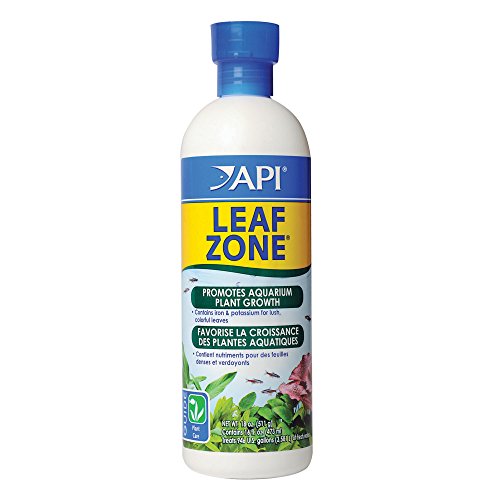
Best for: Weekly feeding of planted freshwater tanks
API LEAF ZONE is a liquid fertilizer for freshwater aquarium plants. It supplies chelated iron and potassium, two nutrients linked to healthier leaf growth and stronger color. The formula is designed for quick uptake by aquatic plants, and the label calls for 5 ml per 10 US gallons of water once a week. That makes dosing fairly simple for small and medium tanks.
The fertilizer is intended to support sturdy leaves and reduce yellowing or decay caused by nutrient shortages. One detail needs attention before ordering: the product title lists an 18-ounce bottle, while the included-item description says 16 ounces. Check the seller’s current packaging and size information. At around $10, it costs less than many specialty plant supplements, but one bottle may not last long in a large aquarium or a heavily planted setup. This product provides nutrients, not light, carbon dioxide, or a complete water-care routine.
Pros
- Chelated iron supports greener, stronger-looking plant leaves.
- Potassium helps supply a key nutrient for freshwater plant growth.
- The 5 ml per 10-gallon dose gives a clear weekly routine.
Cons
- The listed bottle size is inconsistent, with both 16-ounce and 18-ounce descriptions.
- It may run out quickly in large tanks or aquariums packed with plants.
4. Seachem Flourish Excel Plant Supplement

Best for: Low-tech planted freshwater aquariums
Seachem Flourish Excel is a liquid carbon supplement for planted aquariums. This 500 mL bottle provides bioavailable organic carbon, which plants use to build compounds needed for growth and photosynthesis. It also helps keep iron in the ferrous Fe²⁺ form, which plants can generally use more readily than ferric Fe³⁺. Around $12, it costs less than many larger aquarium additives.
The dosing routine is straightforward, but the amount changes after maintenance. Use one 5 mL capful per 40 L, or 10 US gallons, when starting or after a water change above 40%. After that, use one capful per 200 L, or 50 gallons, daily or every other day. Each cap thread measures about 1 mL, which helps with smaller tanks. Flourish Excel is considered safe for fish, but Anacharis needs a slower schedule. Dose every other day instead of daily when that plant is present.
Pros
- Supplies organic carbon without requiring a pressurized CO₂ system.
- Supports iron availability by promoting the Fe²⁺ form.
- The 1 mL cap threads allow smaller doses than a full capful.
Cons
- The initial 5 mL dose can be difficult to measure precisely in nano tanks.
- Aquariums with Anacharis require every-other-day dosing, which limits the standard daily routine.
3. Hygger HC034 Aquarium Plant Liquid Fertilizer

Best for: freshwater tanks needing macronutrients
Hygger CO2 HC034 is a liquid fertilizer for freshwater planted aquariums. Its formula supplies nitrogen, phosphorus, and potassium, the three primary macronutrients plants use for roots, stems, and leaves. The 150 mL bottle costs around $12, though prices can change. At the listed dose of 1 mL per 40 liters, or about 10.57 gallons, it provides up to 150 applications for a tank that size. Larger 500 mL and 1,000 mL bottles are also available.
The included measuring cup makes small doses easier to control than pouring directly from the bottle. The dissolved formula is designed to remain clear instead of clouding aquarium water. It is labeled safe for fish, shrimp, and snails when used as directed, but plant response will still depend on lighting, carbon availability, and the tank’s existing nutrients. HC034 focuses on macro nutrients only, so Hygger recommends pairing it with HC035 Trace Elements for broader plant nutrition. That extra purchase may matter for demanding plants or tanks with pale new growth.
Pros
- Supplies nitrogen, phosphorus, and potassium in one bottle.
- Includes a measuring cup for the 1 mL dose.
- Suitable for freshwater tanks with fish, shrimp, and snails when used correctly.
Cons
- The 150 mL size may run out quickly in larger aquariums.
- It does not provide trace elements, so a second fertilizer may be needed.
2. API CO2 Booster Aquarium Plant Treatment
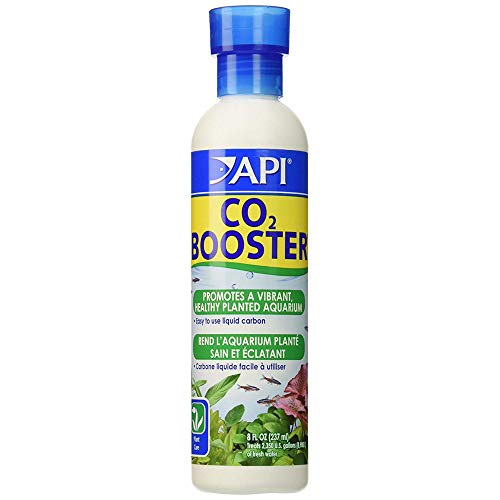
Best for: Daily carbon support in planted tanks
API CO2 Booster is an 8-fluid-ounce bottle of liquid treatment for freshwater aquariums. It adds carbon in a form aquatic plants can absorb from the water, which may support healthier growth when the tank lacks a dedicated carbon source. The package includes one bottle, so buyers should expect a single treatment supply rather than a multi-pack. At around $11, it offers a low-cost way to try a liquid plant supplement.
Its main advantage is flexibility. You can use it by itself or alongside a carbon dioxide system, and the product is designed not to alter aquarium pH levels. That makes it easier to add to an established setup where stable water chemistry matters. The directions call for daily use, not occasional dosing, to maintain the intended carbon input. It suits planted freshwater tanks with low-tech lighting or aquariums where a pressurized CO2 setup feels excessive. Still, liquid carbon cannot replace every benefit of injected CO2, especially in heavily planted tanks with demanding species.
Pros
- The 8-fluid-ounce bottle provides ready-to-use liquid carbon treatment.
- It works alone or alongside an existing CO2 system.
- It adds carbon without altering aquarium pH levels.
Cons
- Daily dosing adds a recurring maintenance task.
- One bottle may not last long in larger aquariums, depending on the required dose.
1. API CO2 Booster Aquarium Plant Treatment

Best for: Daily carbon support in planted tanks
API CO2 Booster is a liquid freshwater aquarium treatment designed to provide carbon for aquatic plants. This package includes one 16-ounce brown bottle, which gives plant keepers a ready supply for routine dosing. Plants can absorb the added carbon directly from the water, so the treatment does not require a pressurized CO2 setup. It can also work alongside an existing CO2 system.
The main advantage is flexibility. You can use it as a standalone carbon source or add it to a tank that already receives injected CO2. The product is intended for daily use, which may help maintain a steady supply for plants that need regular carbon access. It also is designed to avoid changing aquarium pH, a useful detail for fishkeepers who want to keep water chemistry stable. At around $15, the bottle offers a lower-cost option than buying a complete CO2 system, though ongoing use will determine its long-term value.
Pros
- Supplies carbon plants can absorb directly from aquarium water.
- Works with or without a separate CO2 system.
- Designed for daily use without altering aquarium pH levels.
Cons
- Daily dosing requires a consistent maintenance routine.
- A liquid treatment may not provide the same carbon output as a dedicated CO2 injection system for demanding planted tanks.
Buying Guide
The most important factor is livestock and plant safety. Liquid carbon products can contain different active ingredients, and an incorrect dose may harm shrimp, snails, mosses, or sensitive plants.
-
Active ingredient: Check the label for the carbon compound and concentration. Do not assume every bottle works the same way, even when both claim to support plant growth.
-
Tank volume and dose: Choose a product with clear instructions for your aquarium size. Common rates range from 1 milliliter per 10 gallons to 1 milliliter per 20 liters, but follow the exact label.
-
Plant and livestock compatibility: Avoid products that warn against shrimp, snails, Vallisneria, Anacharis, or delicate mosses if your tank contains them. Stop dosing if leaves melt or animals act unusually.
-
Bottle size and cost: Compare the total dose, not just the shelf price. A 16-ounce bottle at 1 milliliter per 10 gallons supplies about 473 doses for a 10-gallon tank, before any startup dose.
-
Application and storage: Look for a measuring cap or syringe and a bottle that closes tightly. A daily dose is easier to control than vague weekly instructions, and most formulas should stay away from children, pets, and direct sunlight.
If you cannot have everything, prioritize proven livestock safety and precise dosing instructions over plant-growth claims.
Frequently Asked Questions
How does liquid carbon help aquarium plants?
Liquid carbon supplements provide a carbon source that can support plant growth, but they do not add gas-injected CO2 to aquarium water. Many formulas use an aldehyde-based compound, so dose only as directed. A common label rate is about 1 milliliter per 10 gallons, but concentrations differ between brands.
What is the safest liquid carbon for planted tanks?
The safest liquid carbon for a planted tank is an aquarium-labeled formula used at or below its stated dose. A cautious approach is starting at half the label dose for seven days, then checking shrimp, snails, and sensitive plants for stress before increasing it.
Can liquid CO2 replace a CO2 injection system?
No, liquid carbon cannot replace a pressurized CO2 injection system because it does not raise dissolved CO2 in the same controlled way. Injection systems can maintain a measurable target, while liquid products act as supplemental carbon sources. For high-light tanks, they are usually not enough to prevent carbon limitation.
Are liquid carbon products safe for shrimp and snails?
Liquid carbon products can be safe for shrimp and snails when the formula is aquarium-labeled and dosed exactly as directed, but safety is not universal. Overdosing can stress livestock, while some products may damage Vallisneria, mosses, or delicate plants. Watch animals after each dose and stop use if you see unusual behavior.
Conclusion
API CO2 Booster Aquarium Plant Treatment is the top pick for planted-tank owners who want a simple liquid carbon supplement without installing a pressurized CO2 system. If your priority is supporting a larger aquarium or a dense carpet of demanding plants, choose a higher-volume formula or a proper injected CO2 kit instead, since liquid products have limits. Before buying, double-check the bottle size, aquarium compatibility, treatment quantity, and current price per dose. Read the dosing directions carefully, especially if your tank contains shrimp, snails, or sensitive plants. Liquid carbon can support growth, but it does not replace suitable light, nutrients, circulation, and regular maintenance. Start conservatively, then adjust only when plants respond well.